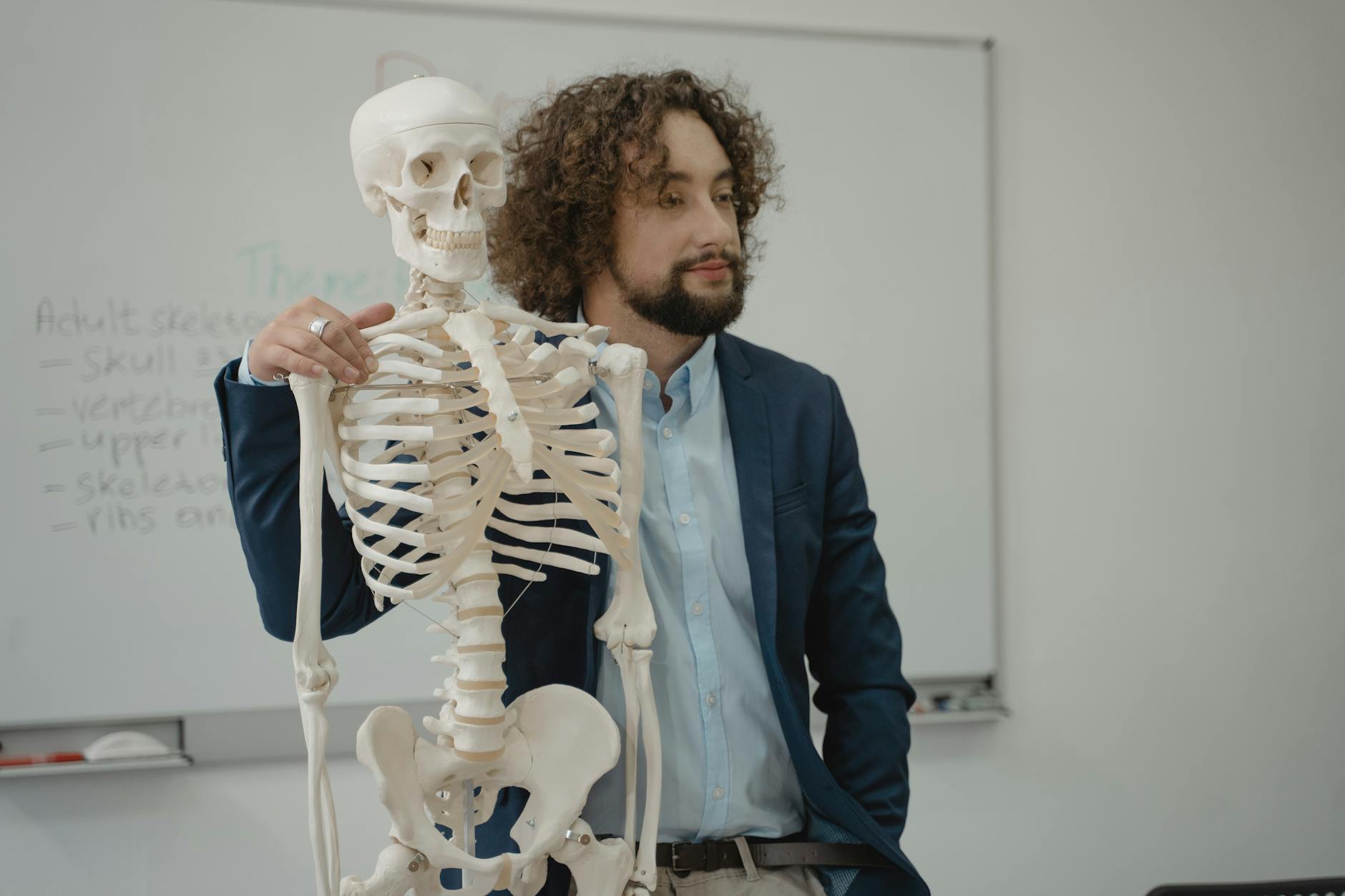
The human stomach produces a new lining every three to four days. If it didn’t, it would digest itself. I’ve opened trivia nights with that fact and watched an entire room of adults go quiet for about two seconds before someone whispered “what the hell” into their beer. That’s the sweet spot I’m always chasing: the place where your own body sounds like science fiction.
I’ve been running live trivia for years, and health questions are a special breed. Everyone thinks they know their own body. Nurses get cocky. Gym bros get cocky. Parents who’ve survived three rounds of stomach flu get very cocky. And then a question about bones or blood or sleep comes along and the whole room learns something new about the thing they’ve been walking around in for decades. These 50 fun health trivia questions and answers are pulled from that experience , from watching confident people get beautifully, entertainingly wrong.
The Stuff You Think You Know
1. What is the largest organ in the human body?
I use this one as a warm-up because half the room shouts “liver” and the other half shouts the right answer. It’s a clean split every time, and the liver people always look personally offended.
Show Answer
The skin. It covers roughly 20 square feet in an average adult. The liver crowd isn’t crazy , it’s the largest internal organ , but the question didn’t say internal, and that distinction is where the fun lives.
2. How many bones does an adult human have?
The number that sticks in people’s heads from school is almost always right on this one. It’s a confidence builder before I pull the rug out later.
Show Answer
206. Babies are born with around 270, but many fuse together as you grow. That follow-up fact usually gets a bigger reaction than the answer itself.
3. What type of blood cell is responsible for fighting infections?
Show Answer
White blood cells (leukocytes). Nearly everyone gets this one, but it earns its spot because it sets up harder blood questions later.
4. What percentage of the human body is water , closer to 40%, 60%, or 80%?
Giving three options makes this one sneaky. People who’ve heard “the body is mostly water” their whole lives tend to overcorrect toward 80%.
Show Answer
About 60%. The “mostly water” framing makes 80% feel right, but 60% is the standard figure for an average adult. It varies by age, sex, and body composition. Common wrong answer: 80%, because “mostly” does a lot of heavy lifting in our memories.
5. What is the medical term for your kneecap?
Show Answer
Patella. One of those words that lives right on the tip of your tongue. I’ve seen people mouth it silently for ten seconds before committing.
6. Which vitamin does your body produce when exposed to sunlight?
Show Answer
Vitamin D. Technically your skin synthesizes it from cholesterol when UVB rays hit it, which means your body is running a tiny chemical factory every time you step outside. That detail tends to land well with the science-curious crowd.
7. What’s the hardest substance in the human body?
People want to say bone. Bone feels hard. Bone sounds tough. But there’s something harder, and most people have chipped it at some point.
Show Answer
Tooth enamel. It’s even harder than bone, ranking about a 5 on the Mohs hardness scale , roughly the same as steel. Common wrong answer: bone, which is strong but more flexible than enamel.
Where Confidence Goes to Die
8. How long is the average adult’s small intestine , closer to 5 feet, 15 feet, or 22 feet?
This is where the room splits three ways and everyone thinks they’re right. The word “small” does real damage here.
Show Answer
About 22 feet. The “small” refers to its diameter, not its length. It’s actually much longer than the large intestine. I’ve had people refuse to believe this until I pulled up a source on my phone.
9. What organ removes old red blood cells from your bloodstream?
Show Answer
The spleen. It filters about 200 milliliters of blood per minute and recycles the iron from old red blood cells. Most people know the spleen exists but have no idea what it actually does, which makes this a satisfying reveal.
10. On average, how many times does the human heart beat per day , closer to 50,000, 100,000, or 200,000?
Show Answer
About 100,000 times per day. At roughly 70 beats per minute, the math checks out. People tend to guess low because the number sounds absurd, but your heart is genuinely tireless.
11. What is the only muscle in the human body attached at only one end?
I love this question because people start mentally scanning their bodies, flexing things under the table, trying to figure it out through pure physical intuition.
Show Answer
The tongue. It’s anchored to the hyoid bone and the floor of the mouth at one end, with the other end completely free. You can feel this if you think about it, which is exactly what every person in the room does the moment they hear the answer.
12. What color is blood when it’s inside your veins and hasn’t been exposed to oxygen?
This one starts arguments. Genuine, table-slapping arguments. People have been told their whole lives that deoxygenated blood is blue, and they will defend that claim with startling conviction.
Show Answer
Dark red. Never blue. Veins look blue through your skin because of how light penetrates tissue and is absorbed at different wavelengths, but the blood itself is always red. Common wrong answer: blue, thanks to every anatomy poster and health textbook diagram that color-coded veins in blue for clarity. One of the most persistent health myths out there.
13. Which human organ can regenerate itself even after up to 75% of it has been removed?
Show Answer
The liver. It’s the only internal organ with this ability, and it can return to its full size within weeks. This is part of why living-donor liver transplants are possible.
14. What’s the smallest bone in the human body?
Show Answer
The stapes (or stirrup bone), located in the middle ear. It’s about 3 millimeters long. Most people remember “it’s in the ear” from school but can’t name the specific bone.
15. How many taste buds does the average human tongue have , closer to 2,000, 10,000, or 50,000?
Show Answer
About 10,000. They regenerate every one to two weeks. The number drops as you age, which is one reason older adults often prefer stronger flavors. That last detail always gets a nod of recognition from the over-50 crowd.
The Body Is Weirder Than You Think
16. What part of your body has no blood supply and gets its nutrients from a fluid called aqueous humor?
Show Answer
The cornea of the eye. It gets oxygen directly from the air and nutrients from the aqueous humor behind it. It’s one of the only tissues in the body that’s completely avascular.
17. Roughly how many bacteria live in the average human mouth , closer to hundreds, millions, or billions?
People always lowball this. Nobody wants to believe the real number.
Show Answer
Billions. Your mouth hosts somewhere between 6 billion and 10 billion bacteria at any given time, spanning over 700 different species. I’ve watched people reach for their water glass immediately after hearing this.
18. What common bodily function temporarily stops your heart?
Show Answer
Sneezing. The change in pressure in your chest during a sneeze can briefly alter your heart rhythm, though it doesn’t technically “stop” in the flatline sense. The old myth that your heart stops completely is an exaggeration, but the electrical disruption is real.
19. Which part of the human body cannot repair itself?
There are a few technically correct answers here, but the one I’m looking for is the one that surprises people most.
Show Answer
Tooth enamel. Once it’s damaged or worn away, your body can’t regenerate it. Unlike bone, skin, or even liver tissue, enamel has no living cells to drive repair. This is why dentists get so intense about prevention.
20. How fast does a sneeze travel , closer to 5 mph, 50 mph, or 100 mph?
Show Answer
About 100 mph. Some studies have clocked sneezes even faster. This is why “sneeze into your elbow” became such a public health mantra. The droplets travel far and fast.
21. What percentage of your bones are located in your hands and feet , closer to 25%, 50%, or 75%?
This is one of my favorite questions to ask because every option sounds plausible and the correct answer feels impossibly high.
Show Answer
Over 50%. Your two hands contain 54 bones, and your two feet contain 52. That’s 106 out of 206. People almost never guess this high, and the realization that more than half your skeleton is below your wrists and ankles genuinely shifts how you think about your body.
22. What’s the only part of the body with no nerve endings?
Show Answer
The brain itself. It can’t feel pain, which is why brain surgery can be performed on awake patients. The headache you feel comes from surrounding tissues, blood vessels, and membranes , not the brain itself.
23. How much saliva does the average person produce in a lifetime , closer to a bathtub’s worth, a swimming pool’s worth, or enough to fill two swimming pools?
Show Answer
About two swimming pools’ worth , roughly 25,000 quarts over a lifetime. People almost always guess too low. Your salivary glands are quietly prolific.
Nutrition Myths and Kitchen Table Arguments
24. Which vitamin can be toxic if consumed in large quantities because it’s stored in body fat rather than excreted?
Show Answer
Vitamin A (and technically all fat-soluble vitamins: A, D, E, and K). But Vitamin A toxicity is the classic example. Arctic explorers reportedly got sick from eating polar bear liver, which contains lethal concentrations of it.
25. What mineral is the most abundant in the human body?
Show Answer
Calcium. About 99% of it is stored in your bones and teeth. People sometimes guess iron because they associate it with blood, but iron is present in much smaller quantities.
26. True or false: Carrots significantly improve your night vision.
This one always gets a confident “true” from about 70% of the room. The backstory is better than the answer.
Show Answer
Mostly false. Carrots contain beta-carotene, which supports eye health, but they won’t give you superhuman night vision. The myth was amplified by British propaganda during WWII to hide the fact that the RAF was using radar technology. They credited their pilots’ accuracy to a carrot-rich diet. That propaganda detail usually gets the biggest reaction of the night.
27. What’s the recommended daily water intake for an average adult , is it actually eight glasses?
Show Answer
There’s no solid scientific basis for the “eight glasses a day” rule. The National Academies of Sciences suggests about 3.7 liters for men and 2.7 liters for women from all beverages and food combined. The eight-glass rule likely traces back to a 1945 recommendation that included water from food, but that second part got lost. People get genuinely upset when they learn this one.
28. Which fruit has more potassium per serving than a banana , avocado, apple, or grape?
Show Answer
Avocado. A single avocado contains about 975 mg of potassium compared to a banana’s roughly 422 mg. Bananas somehow became the poster child for potassium, and they’re fine, but they’re not even in the top five potassium-rich foods.
29. What does the “B” stand for in vitamin B12?
This one catches people mid-thought because they realize they’ve never actually questioned it.
Show Answer
Nothing specific , the B vitamins are simply numbered in the order they were discovered. The letter B was assigned early in vitamin research, and the numbering system stuck. There are gaps in the sequence (no B4, B8, etc.) because some were later reclassified as non-vitamins.
30. What common spice has been shown in studies to help regulate blood sugar levels?
Show Answer
Cinnamon. Multiple studies have shown it can improve insulin sensitivity and lower fasting blood sugar. It’s not a replacement for medication, but the research is real and ongoing.
Sleep, Stress, and the Things That Keep You Up
31. During which stage of sleep does the body do most of its physical repair , REM or deep sleep?
Show Answer
Deep sleep (also called slow-wave sleep or Stage 3 NREM). Growth hormone is primarily released during this phase, driving tissue repair and muscle growth. REM gets all the press because of dreaming, but deep sleep is where the body does its maintenance work.
32. On average, how long does it take a healthy person to fall asleep , closer to 2 minutes, 7 minutes, or 15 minutes?
Show Answer
About 10 to 15 minutes. If you fall asleep the instant your head hits the pillow, that’s actually a sign of sleep deprivation, not healthy sleep. This fact tends to make insomniacs feel slightly better and fast sleepers slightly worse.
33. What hormone is primarily responsible for making you feel sleepy?
Show Answer
Melatonin. Produced by the pineal gland, its release is triggered by darkness. This is why screen light before bed actually matters , blue light suppresses melatonin production. Common wrong answer: serotonin, which is a precursor to melatonin but doesn’t directly cause sleepiness.
34. What happens to your sense of smell while you sleep?
Show Answer
It essentially shuts off. Unlike sounds, which can wake you, smells generally won’t pull you out of sleep. This is why smoke detectors exist , you can’t rely on smelling smoke while you’re asleep. I’ve seen this answer visibly unsettle people, which is exactly the right reaction.
35. What is the stress hormone that’s released during the “fight or flight” response?
Show Answer
Cortisol (along with adrenaline/epinephrine). Cortisol is the sustained-stress hormone, while adrenaline handles the immediate spike. Most people say adrenaline, which isn’t wrong, but cortisol is the more medically significant answer when talking about chronic stress.
Questions That Sound Made Up But Aren’t
36. How many times per day does the average person pass gas , closer to 5, 14, or 25?
Nobody answers this one quietly. Every table has an opinion, and someone always claims they’re well below average.
Show Answer
About 14 times per day. It’s completely normal and mostly odorless. The room always erupts at this one, and someone inevitably starts counting on their fingers.
37. What color does your blood appear in a vein when viewed through a pulse oximeter?
Show Answer
Red. Pulse oximeters work by shining red and infrared light through your finger and measuring how much is absorbed. Oxygenated blood absorbs more infrared; deoxygenated blood absorbs more red. But both types are red , the device just measures the shade.
38. How long can the human brain survive without oxygen before permanent damage begins , closer to 30 seconds, 4 minutes, or 15 minutes?
Show Answer
About 4 to 6 minutes. Brain cells begin dying rapidly after that window. This is why CPR timing is so critical and why every second counts in cardiac arrest. The number is sobering and tends to quiet a room.
39. True or false: you lose most of your body heat through your head.
Show Answer
False. Your head accounts for about 10% of your body’s surface area, and heat loss is roughly proportional to exposed skin area. The myth likely originated from a flawed 1950s military study where subjects wore insulated suits but no hats. Of course they lost heat through their heads , it was the only part uncovered.
40. What is the average lifespan of a human red blood cell , closer to 24 hours, 120 days, or 1 year?
Show Answer
About 120 days. Your body produces roughly 2 million new red blood cells every second to keep up with the turnover. That production rate is one of those numbers that makes you appreciate the machinery running under your skin.
41. Which grows faster: fingernails or toenails?
Show Answer
Fingernails. They grow about 3 to 4 millimeters per month, compared to about 1 millimeter per month for toenails. The leading theory is that fingernails grow faster because they experience more trauma and use, which stimulates growth.
42. What is the name of the condition where someone can’t recognize faces, even those of close family members?
Show Answer
Prosopagnosia, also called face blindness. It affects about 2.5% of the population to some degree. The word itself comes from the Greek “prosopon” (face) and “agnosia” (not knowing). Brad Pitt has publicly discussed living with it.
The Ones That Separate the Tables
43. What is the rarest blood type in the ABO system?
Show Answer
AB negative. Only about 1% of the population has it. People often guess O negative because they’ve heard it’s the “universal donor,” but being rare as a donor type and being rare as a blood type are different conversations.
44. What is the medical term for the “funny bone” sensation when you hit your elbow?
This is really two questions in one: what nerve is involved, and why is it called the “funny bone”?
Show Answer
The ulnar nerve. And the name “funny bone” is likely a pun on the humerus bone it runs near. When you hit your elbow in just the right spot, you’re compressing the ulnar nerve against the bone, which sends that sharp, tingling sensation down your arm. Not funny at all, really.
45. How many muscles does it take to take a single step while walking?
Show Answer
About 200 muscles are involved in a single step. The coordination required is staggering, which is part of why building robots that walk naturally is so difficult. Your body does it without you thinking about it once.
46. What organ is responsible for producing insulin?
Show Answer
The pancreas. Specifically, the beta cells in the islets of Langerhans. Most people get this right, but very few can name the specific cell clusters, and that’s a nice bonus point opportunity.
47. What percentage of the human genome do we share with bananas , closer to 10%, 30%, or 60%?
I’ve closed rounds with this question just to watch the look on people’s faces.
Show Answer
About 60%. We share DNA with bananas because all life on Earth descends from common ancestors, and many fundamental cellular processes are the same across species. The number always gets a laugh, followed by a long pause, followed by someone saying “I knew it” about their coworker.
48. What is the only bone in the human body that doesn’t articulate with any other bone?
Show Answer
The hyoid bone, located in the throat. It’s anchored by muscles and ligaments and supports the tongue. It’s also important in forensic science , a fractured hyoid can indicate strangulation.
49. What common kitchen ingredient was used as an antiseptic on battlefields before modern antibiotics?
Show Answer
Honey. Its low moisture content and slight acidity create an environment hostile to bacteria. It was used in wound care for centuries, fell out of favor with modern medicine, and has recently been reintroduced in medical-grade form for treating burns and chronic wounds. History coming full circle.
The Last One You’ll Be Thinking About Tomorrow
50. Every atom in your body is billions of years old. But how often does the human body effectively replace all of its cells , how many years until you’re made of entirely “new” material?
I save this one for last because it’s not really a trivia question. It’s a thought experiment disguised as one. People sit with it. They argue about what “you” even means if every piece of you gets swapped out. It’s the kind of question that makes someone stare at their own hands on the drive home.
Show Answer
Roughly 7 to 10 years. Most cells are replaced much faster , stomach lining every few days, red blood cells every four months, skin cells every two to three weeks. But some cells, like certain neurons and cells in the lens of your eye, may last your entire lifetime. So you’re never entirely new. There’s always something original left, carrying the thread of who you’ve been from the very beginning.
Science and nature rounds have a reputation for being the quizmasters' revenge. I write mine from Phoenix, AZ with the opposite goal: questions where genuine curiosity gets rewarded. 14 years of writing them has convinced me that's possible. I've contributed question sets to Sporcle, and I take the same care with every set I write.
Latest posts by Nicole Martin
(see all)