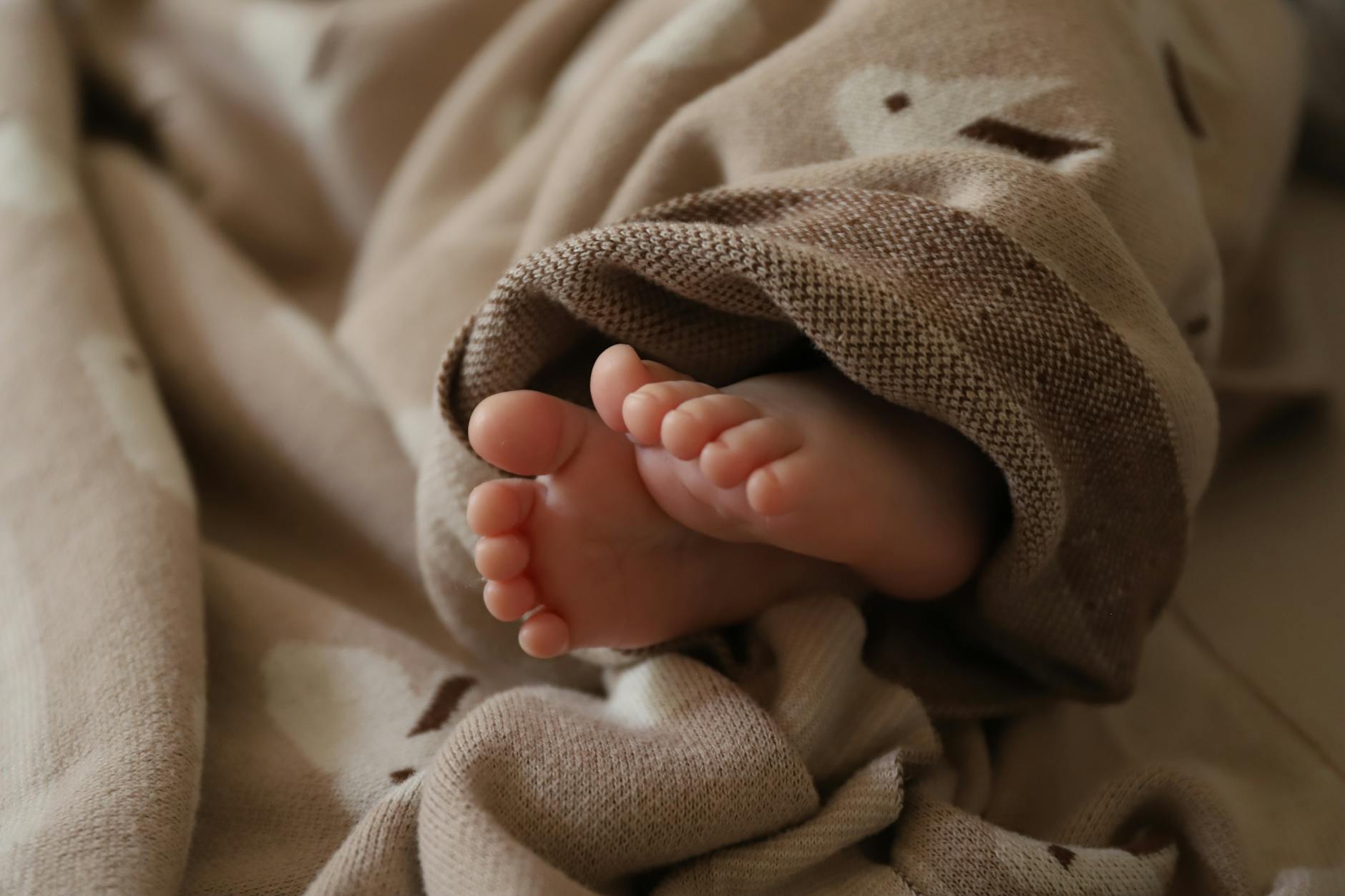
A human baby is the only primate that can’t cling to its mother at birth. Every other primate infant grips fur, hangs on, moves with the group. Ours just lie there. That single fact sits underneath everything else about babies: they are spectacularly, almost absurdly helpless, and yet the species that starts out the most dependent ends up running the planet. Baby trivia lives in that gap between what we assume and what’s actually happening inside those tiny, soft-skulled heads.
The people who search for baby trivia tend to fall into two camps. There’s the baby shower planner who needs questions that’ll make a room of adults laugh and argue. And there’s the parent who’s convinced they’ve absorbed every fact through sheer sleep-deprived osmosis. Both groups are about to get humbled in slightly different ways.
The Stuff You Think You Know
1. How many bones does a newborn baby have?
I’ve watched tables of parents lock in “206” with absolute confidence. That’s the adult count, and it’s wrong. Babies start with more, not fewer. Many of those bones are cartilage that fuses over time, which is part of why they’re so bendy and so hard to break.
Show Answer
Approximately 300. The most common wrong answer is 206, which is the adult count. The brain retrieves the number it learned in school and doesn’t question whether it applies to newborns.
2. What color are most Caucasian babies’ eyes at birth?
This one’s a layup for parents, but it catches childless folks off guard every time. Melanin hasn’t finished doing its work yet, which is why so many baby photos feature those striking pale eyes that won’t last.
Show Answer
Blue or blue-gray. Eye color can take up to three years to fully settle, though most of the change happens in the first six to nine months.
3. On average, how many diapers does a baby go through in the first year of life?
At baby showers, I give this as a range question: closest without going over. Parents always guess higher than non-parents. Both groups tend to lowball it.
Show Answer
Approximately 2,500. Some estimates run as high as 3,000. That’s roughly seven a day, which sounds right to anyone who’s lived it and sounds impossible to anyone who hasn’t.
4. What’s the soft spot on a baby’s head called?
Almost everyone knows there’s a soft spot. Fewer people can name it. And almost nobody knows there are actually two of them.
Show Answer
A fontanelle (or fontanel). There are two: the anterior fontanelle on top, which closes around 18 months, and the smaller posterior fontanelle at the back, which closes by about 2 months.
5. True or false: Newborn babies cry without tears.
This is one of those questions where people who’ve recently had a baby will nail it, and everyone else will argue about it for five minutes. The screaming is very real. The tears are not.
Show Answer
True. Newborns can cry loudly from birth, but tear ducts aren’t fully developed until around two weeks to two months of age. Some babies don’t produce visible tears for even longer.
Where the Floor Gets Slippery
6. What is the average weight of a full-term newborn in the United States?
I give this in pounds because the room will shout out guesses like an auction. People anchor on their own kids’ birth weights, which makes this one personal and therefore unreliable.
Show Answer
About 7.5 pounds (3.4 kg). The common wrong answers cluster around 6 pounds (too low, that’s closer to early-term) and 9 pounds (which is large but not unusual).
7. At what age do most babies say their first recognizable word?
This starts arguments. Not about the answer, but about what counts as a word. “Mama” at six months when the baby is clearly just making sounds? Parents will die on that hill.
Show Answer
Around 12 months. Most pediatric guidelines place the first intentional, context-appropriate word at about one year, though babbling with consonant-vowel combinations starts around 6 months.
8. Which sense is the most developed in a newborn at birth?
People split between hearing and touch on this one. Both are well-developed, but one of them was getting a workout in the womb for months before birth.
Show Answer
Hearing. Babies can hear and respond to sounds from the third trimester. They recognize their mother’s voice at birth. Touch is a close second, but hearing has the head start.
9. How far can a newborn baby see clearly?
I love this question because people always overestimate it. They picture a baby looking around the room, taking it all in. The reality is much more intimate than that.
Show Answer
About 8 to 12 inches , roughly the distance from the crook of an arm to a parent’s face during feeding. Everything beyond that is a blur. It’s one of those facts that feels designed on purpose.
10. What percentage of a newborn’s body weight is their head?
When I ask this at events, people instinctively look at each other’s heads and try to do math. The number is higher than anyone guesses, and it explains a lot about why babies can’t hold their heads up.
Show Answer
About 25% , one quarter of their total body weight. For adults, the head is only about 10%. This ratio is why neck control is such a major early milestone.
The Ones That Start Debates
11. What is the most popular birth month in the United States?
Count back nine months from the answer and you’ll land on the holidays. The room always does that math out loud, and it always gets a laugh.
Show Answer
September. The most common individual birth date in the U.S. is September 9th. December holidays do the obvious arithmetic.
12. How many taste buds does a newborn have compared to an adult?
People assume babies taste less because they seem to eat anything. The truth is the opposite, and it reframes every grimace you’ve ever seen a baby make at pureed peas.
Show Answer
Newborns have about three times more taste buds than adults , roughly 10,000 compared to an adult’s 2,000-4,000. They’re spread across the tongue, roof of the mouth, and even the throat.
13. True or false: Babies are born with kneecaps.
This is a classic baby trivia question and it trips people up because the answer sounds like an urban myth either way. The truth is somewhere in the middle, and it depends on how strict your definition of “kneecap” is.
Show Answer
Technically false , or at least misleading. Babies are born with cartilage where the kneecap will be, but the patella doesn’t fully ossify into bone until around age 3 to 5. They have the structure, just not the hard version.
14. What is vernix caseosa?
Parents who had natural births tend to get this. Everyone else looks at you like you’re making words up. It’s the kind of term that sounds clinical until you learn what it actually does.
Show Answer
The white, waxy coating on a newborn’s skin at birth. It protects the baby’s skin in the womb and has antimicrobial properties. Many hospitals now delay the first bath to let the skin absorb it.
15. How many hours a day does the average newborn sleep?
Every parent in the room will groan at this question, because the total number of hours sounds generous until you remember they come in 45-minute installments spread across the entire 24-hour cycle.
Show Answer
14 to 17 hours. It sounds like a lot. It does not feel like a lot.
16. What was the most popular baby name in the United States in 2023?
Name questions are gold at baby showers because everyone has an opinion and nobody checks the data. The top names shift less dramatically year to year than people think.
Show Answer
Olivia for girls (holding the top spot since 2019) and Liam for boys (on top since 2017). People often guess Emma or Noah, which were recent champions but have since slipped.
Now It Gets Weird
17. Babies are born without which specific bacteria in their digestive system?
This is a trick in the best way. The answer isn’t one specific bacterium. It’s all of them.
Show Answer
Babies are born with a virtually sterile gut , no bacteria at all. Colonization begins during birth (especially vaginal delivery) and through breastfeeding, skin contact, and the environment. The gut microbiome takes years to fully develop.
18. Can newborn babies swim?
This one makes people nervous to answer, which is exactly why I ask it. Nobody wants to be wrong about baby safety. But there’s a real, documented reflex at work here.
Show Answer
Newborns have a “bradycardic response” , when submerged, they instinctively hold their breath and their heart rate slows. They also have a swimming reflex that causes them to paddle. This is NOT the same as being able to swim safely. The reflexes fade by about 6 months.
19. What is the Moro reflex?
If you’ve ever watched a sleeping baby suddenly throw their arms out like they’re falling off a cliff, you’ve seen it. You just didn’t know it had a name.
Show Answer
The startle reflex , when a baby suddenly extends their arms, arches their back, and then pulls their arms back in, often crying. It’s present from birth and typically disappears by 3 to 4 months. It’s thought to be a primitive response to the sensation of falling.
20. True or false: A baby can recognize its mother’s voice from the moment it’s born.
This one usually gets a split room. It sounds too sentimental to be science. But it is science, and the evidence is beautiful.
Show Answer
True. Studies show that newborns prefer their mother’s voice over other voices within hours of birth. They’ve been hearing it, muffled but consistent, for the last trimester. Research using modified pacifiers showed babies would change their sucking patterns to hear their mother’s voice over a stranger’s.
21. How much does the average baby’s brain grow in the first year?
I usually frame this as a multiple choice: does it double, triple, or stay roughly the same? The answer is staggering when you think about what it means in terms of sheer neural construction.
Show Answer
It more than doubles in size. A newborn’s brain is about 25% of its adult size at birth and reaches about 60% by the end of the first year. By age 3, it’s at 80%. The rate of growth in that first year is faster than at any other point in life.
The Home Stretch
22. What is the term for the fine, downy hair that covers some newborns’ bodies?
Parents who’ve seen it never forget it. It can be startling if you’re not expecting it, especially on the shoulders and back. It’s completely normal and has a lovely name.
Show Answer
Lanugo. It develops around the fifth month of pregnancy and usually sheds before birth, but premature babies and some full-term babies are still covered in it. It falls out within a few weeks.
23. In what country is it traditional to gift gold jewelry to a newborn baby?
This is a question where multiple answers could be correct, which is what makes it interesting. I’m looking for the culture where it’s most deeply embedded as a universal practice.
Show Answer
India , though gold gifting for newborns is also traditional in many Middle Eastern and Mediterranean cultures. In India, gold is considered auspicious and is often the first gift a baby receives, sometimes within hours of birth.
24. What is the world record for the heaviest baby ever born?
I save the jaw-drop questions for near the end. People guess in the 12 to 14 pound range. They are not prepared.
Show Answer
22 pounds, 8 ounces (10.2 kg), born in Aversa, Italy, in 1955. The baby was over two feet long. To put that in perspective, many one-year-olds don’t weigh 22 pounds. The mother, Anna Bates, was 7’11” tall. (Note: some sources cite a slightly different record from Canada in 1879, also involving Anna Bates , the records overlap due to historical documentation.)
25. A newborn baby has approximately 70 more of these than an adult human. What are they?
I’ve closed dozens of nights on a version of this question. It brings the whole evening full circle because it connects to something we covered early on, but from a completely different angle. The room goes quiet. People mouth numbers to themselves. Someone whispers “bones” and then second-guesses it. And the thing is, they’re right. A newborn starts with roughly 300 bones. An adult has 206. That difference of about 94 bones isn’t because we lose them. They fuse. The baby you were is literally inside the adult you became, just compressed, merged, hardened into something that can stand up and walk out of a trivia night feeling a little more amazed by the whole business of being alive than when they walked in.
Show Answer
Bones. Newborns have approximately 300 bones compared to the 206 in an adult skeleton. The “extra” bones are mostly cartilage that gradually fuses as the child grows.
I write family trivia for the game nights where everyone, from the youngest to the oldest, is actually in the game. Based in Berlin, Germany for 8 years, my questions are clean, fair, and genuinely fun.
Latest posts by Isabella Russo, B.Ed. Primary Education
(see all)