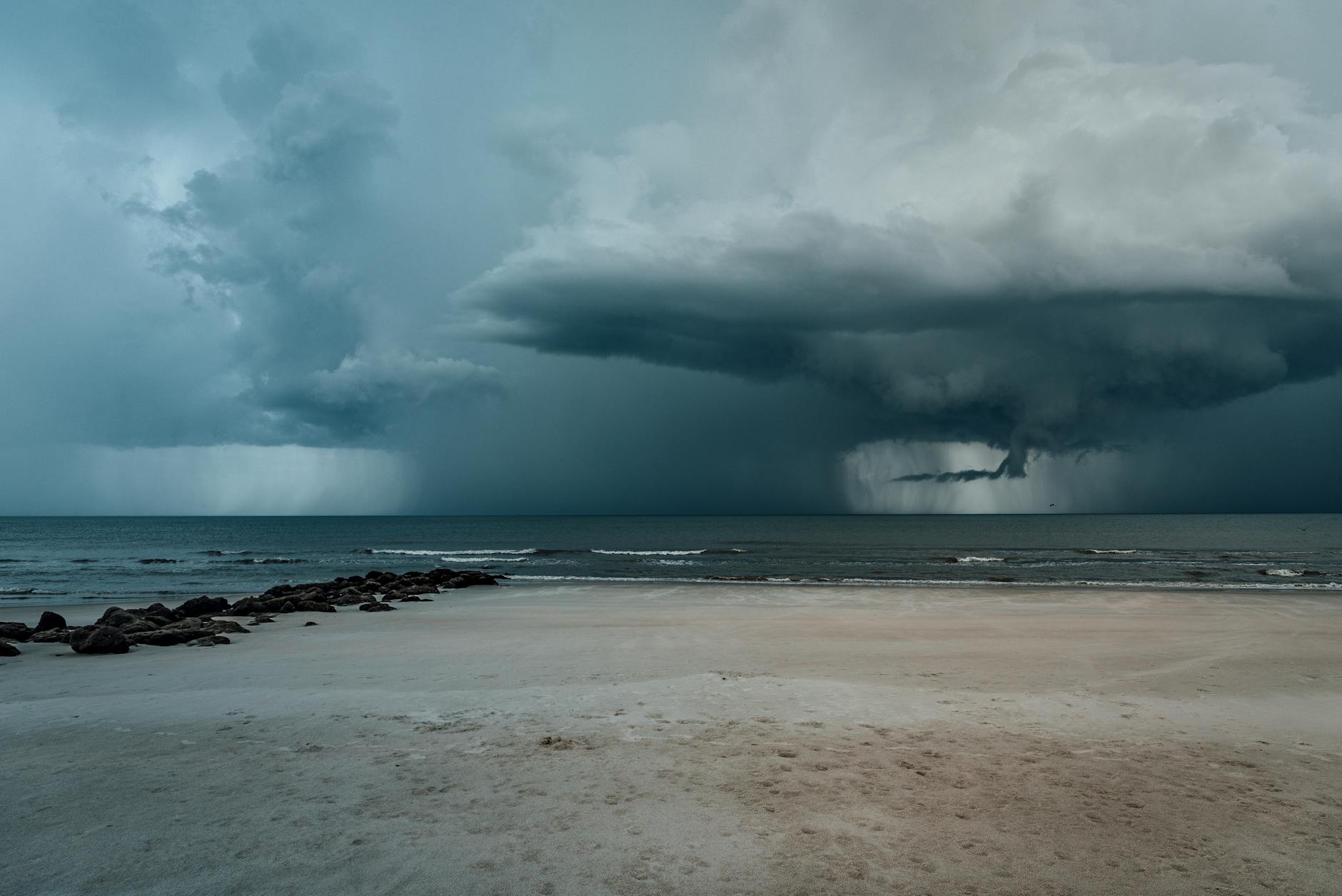
Lightning is hotter than the surface of the sun. Most people know that. What they don’t know is how much hotter. Five times. And when I drop that number in a room, I can see the exact moment people recalibrate everything they thought they understood about what’s happening above their heads during a thunderstorm. That recalibration is what weather trivia does better than almost any other category. Everyone has opinions about weather. Everyone has looked at a sky and made a prediction. And almost everyone is overconfident about it.
The person searching for weather trivia already knows their Fujita scale from their Saffir-Simpson. They’ve watched enough Weather Channel to feel dangerous. They probably know what a derecho is. But they’ve got blind spots in the places where folk wisdom meets actual atmospheric science, and that’s where these questions live. I’ve run weather rounds at pub trivia for years, and I can tell you: the room gets loud. People argue about wind. They argue about temperature. They argue about whether hail can really get that big. It’s beautiful.
Here are 50 weather trivia questions, sequenced the way I’d run them in a room full of people who think they know weather.
The Sky Looks Simple Until You Ask Questions About It
1. What instrument measures atmospheric pressure?
I start easy on purpose. You want the room feeling smart before you start taking things away from them. This one’s a confidence builder, and it works because about 15% of the room will second-guess themselves between barometer and thermometer.
2. What scale is used to measure tornado intensity based on estimated wind speeds and resulting damage?
Some people will say Fujita. Some will say Enhanced Fujita. Both answers tell me something about the person. The original Fujita Scale was retired in 2007, and the Enhanced Fujita (EF) Scale replaced it. I accept both in a casual round but give a bonus point for knowing the distinction.
Show Answer
The Enhanced Fujita (EF) Scale. Common wrong answer: the Richter Scale, which measures earthquakes. The brain reaches for the most famous measurement scale it can find.
3. Cumulus, stratus, and cirrus are the three main types of what?
Clouds. Simple. But I’ve had a table argue for a solid minute about whether nimbus was one of the main three. It’s not. It’s a prefix meaning rain-bearing. That argument is worth the question.
4. What’s the term for the temperature at which air becomes saturated and water vapor begins to condense?
People either know this instantly or they’ve never encountered the term. There’s no middle ground.
5. In which layer of the atmosphere does most weather occur?
This is the kind of question that separates the people who paid attention in seventh grade from the people who are faking it. Four layers to choose from, and only one of them matters for this conversation.
Show Answer
The troposphere. Common wrong answer: the stratosphere. People remember that word because it sounds more dramatic, but the stratosphere is actually remarkably calm. That’s why planes cruise there.
6. What color does the sky sometimes turn before a tornado?
I love this question because the answer sounds made up. People who’ve seen it in person will nail it immediately. Everyone else thinks you’re messing with them.
Show Answer
Green (often described as a greenish-yellow). Scientists still debate exactly why this happens, but the leading theory involves the interaction of reddish sunset light with the blue water and ice content of severe storm clouds.
7. What phenomenon causes the wind to appear to deflect to the right in the Northern Hemisphere and to the left in the Southern Hemisphere?
This is where the bathroom myth comes in. Someone always brings up toilets. The Coriolis effect does influence large-scale systems like hurricanes, but it has virtually no effect on the water in your toilet. That’s just the shape of the bowl.
Show Answer
The Coriolis effect
Where Confidence Goes to Die
8. What is the highest temperature ever reliably recorded on Earth’s surface?
People guess high. They guess 140°F, 150°F. The real number feels almost modest compared to what they expect, which is what makes it interesting.
Show Answer
134°F (56.7°C), recorded at Furnace Creek Ranch in Death Valley, California, on July 10, 1913. There’s ongoing debate about the reliability of this reading, with some climatologists arguing a 2013 measurement of 129.2°F in the same valley might be more trustworthy.
9. What country experiences the most tornadoes per year?
Everyone gets this one. But the follow-up is where it gets fun.
Show Answer
The United States, with roughly 1,200 tornadoes annually
10. Which country has the most tornadoes per square mile? It’s not the United States.
This is the follow-up. And the room goes quiet. I’ve watched confident meteorology buffs crumble here. The answer is a country most people associate with tea and mild complaints about drizzle.
Show Answer
England. The UK as a whole averages about 30-50 tornadoes per year, and given its small land area, that density is higher than the US. They’re mostly weak, but they count.
11. What’s the fastest wind speed ever recorded on Earth’s surface, not including tornadoes?
The distinction matters. Tornado wind speeds are estimated from damage, not directly measured. Surface station records are a different animal entirely.
Show Answer
253 mph (408 km/h), recorded during Tropical Cyclone Olivia on Barrow Island, Australia, on April 10, 1996. Common wrong answer: Mount Washington’s 231 mph, which held the record for 62 years before Olivia broke it.
12. What is a haboob?
I ask this one partly for the name. The room always laughs. Then they get serious, because they realize they don’t actually know.
Show Answer
A type of intense dust storm or sandstorm, typically caused by the downdraft of a collapsing thunderstorm. Common in the Sahara and the American Southwest.
13. What weather phenomenon is known as a “pogonip” in the western United States?
This is an obscure one, and I use it to thin the herd. Nobody gets it. That’s the point. Sometimes a question exists to make the answer memorable.
Show Answer
A dense ice fog. The word comes from the Shoshone language and describes a freezing fog so thick that ice crystals form in the air and can be inhaled. It’s genuinely dangerous.
14. What is the lowest temperature ever recorded on Earth?
People lowball this one. They say minus 80, minus 90. The real number is colder than they think anything on this planet can get.
Show Answer
-128.6°F (-89.2°C), recorded at the Soviet Vostok Station in Antarctica on July 21, 1983. At that temperature, steel becomes brittle and exposed skin freezes in seconds.
15. What’s the difference between sleet and freezing rain?
This one starts arguments that last longer than the trivia round. People who grew up in cold climates will physically lean forward. The distinction is simple but almost nobody gets it exactly right.
Show Answer
Sleet freezes before it hits the ground (ice pellets that bounce). Freezing rain is liquid when it falls but freezes on contact with cold surfaces. The difference is the depth of the warm layer the precipitation passes through on the way down.
Numbers That Don’t Sound Real
16. Roughly how many thunderstorms are happening on Earth at any given moment?
I give a range for this one. Within a thousand is close enough. But people’s guesses span from 50 to a million, and the spread is always entertaining.
Show Answer
Approximately 1,800. That works out to about 16 million thunderstorms per year across the planet.
17. How hot is a bolt of lightning?
This is the one I mentioned at the top. People know it’s hot. They don’t know it’s approximately 30,000 Kelvin hot.
Show Answer
Approximately 54,000°F (30,000 K), which is roughly five times hotter than the surface of the sun.
18. What is the largest hailstone ever recorded in the United States, by diameter?
People guess golf ball, maybe baseball. The real answer is the kind of thing that makes you rethink what ice can do.
Show Answer
8 inches in diameter, found in Vivian, South Dakota, on July 23, 2010. That’s roughly the size of a volleyball. It weighed nearly two pounds.
19. What’s the wettest place on Earth by average annual rainfall?
Two places compete for this title depending on which measurement period you use, and both are worth knowing. The one most reference books cite is in India.
Show Answer
Mawsynram, India, in the Meghalaya state, with an average annual rainfall of about 467 inches (11,871 mm). Common wrong answer: Cherrapunji, which is just 10 miles away and held the record for decades. They’re essentially arguing with themselves.
20. In what year was the deadliest tornado in U.S. history?
People guess the 1900s or even the 1800s. They’re right to go old. Modern warning systems have changed everything, and the death toll of the correct answer is staggering by today’s standards.
Show Answer
1925. The Tri-State Tornado killed 695 people across Missouri, Illinois, and Indiana on March 18, 1925. It traveled 219 miles, the longest continuous track of any tornado in recorded history.
21. What percentage of the Earth’s water is in the atmosphere at any given time?
The answer to this one makes people blink. It’s so small it seems impossible that it could produce the storms we see.
Show Answer
About 0.001%. All the rain, all the snow, all the hurricanes, all of it comes from one thousandth of one percent of Earth’s water being in the atmosphere at a time.
22. What is the driest place on Earth?
The Sahara is the wrong answer, and a lot of people know that. But which specific place you name depends on how you define “driest,” and that’s where it gets interesting.
Show Answer
The Dry Valleys of Antarctica, which have received essentially no precipitation for roughly two million years. Common wrong answer: the Atacama Desert in Chile, which is the driest hot desert and hasn’t seen rain in some areas for over 400 years. Both answers are defensible depending on context.
The Part Where Hurricanes Get Complicated
23. What’s the difference between a hurricane, a typhoon, and a cyclone?
This is my favorite weather trivia question of all time because the answer is so beautifully anticlimactic.
Show Answer
Nothing. They’re the same phenomenon. The name depends on location: hurricanes form in the Atlantic and Northeast Pacific, typhoons in the Northwest Pacific, and cyclones in the South Pacific and Indian Ocean.
24. What is the eye wall of a hurricane?
People confuse the eye with the eye wall constantly. The eye is the calm center. The eye wall is the opposite of calm.
Show Answer
The ring of towering thunderstorms immediately surrounding the eye. It contains the hurricane’s strongest winds and heaviest rainfall. It’s the most violent part of the entire storm.
25. In what direction do hurricanes rotate in the Northern Hemisphere?
This trips up more people than you’d think. The Coriolis effect is back, and people who got question 7 right sometimes get this one wrong because they overthink the application.
Show Answer
Counterclockwise. In the Southern Hemisphere, cyclones rotate clockwise.
26. What category was Hurricane Katrina when it made landfall in Louisiana in 2005?
I’ve asked this hundreds of times. The most common answer is Category 5. It wasn’t. And the distinction matters because it reveals how much of Katrina’s devastation was about infrastructure failure, not wind speed alone.
Show Answer
Category 3. Katrina reached Category 5 over the Gulf of Mexico but weakened before landfall. The catastrophic flooding in New Orleans was primarily caused by levee failures, not the storm’s wind category at landfall.
27. What are hurricane names retired for?
Most people know hurricanes have names. Fewer know that some names get permanently removed from the rotation, or why.
Show Answer
A hurricane name is retired when the storm is so deadly or costly that using the name again would be considered insensitive. Katrina, Harvey, Maria, and Sandy are all retired. The World Meteorological Organization makes the call.
28. What was the strongest Atlantic hurricane ever recorded by sustained wind speed?
People always guess Katrina or Andrew. The actual answer is a storm that most Americans have never heard of because it barely affected the US mainland.
Show Answer
Hurricane Allen in 1980, with sustained winds of 190 mph. Some sources cite Hurricane Patricia (2015) in the Eastern Pacific at 215 mph, but Allen holds the Atlantic record.
29. What was the first year that both male and female names were used for Atlantic hurricanes?
Before this, all hurricanes had female names. The change happened later than most people think.
Show Answer
1979. The practice of using only female names had been in place since 1953. The switch was the result of pressure from feminist groups who argued the naming convention was sexist.
Things You Thought You Knew But Didn’t
30. What causes thunder?
This sounds like a kids’ question. It’s not. Ask ten adults and you’ll get ten slightly different answers, most of them wrong or incomplete. The real mechanism is more violent than people imagine.
Show Answer
The rapid expansion and contraction of air heated by a lightning bolt. The lightning superheats the surrounding air to around 30,000 K almost instantaneously, causing it to expand explosively faster than the speed of sound. That shockwave is thunder.
31. Can it be too cold to snow?
This is a yes/no question, which I rarely use. But the debate it creates is worth it. People have strong feelings about this.
Show Answer
Technically, no. It can snow at any temperature below freezing. But extremely cold air holds very little moisture, so snowfall becomes increasingly rare and light as temperatures drop well below zero. At -40°F, the air is so dry that significant snowfall is almost impossible, which is why Antarctica’s interior is technically a desert.
32. What is a microburst?
This is one of those terms people have heard on the news without ever really understanding. The answer is scarier than they expect.
Show Answer
A localized column of sinking air within a thunderstorm that produces damaging divergent winds at or near the surface. Microbursts can produce wind speeds exceeding 100 mph in an area less than 2.5 miles across. They’ve caused multiple plane crashes and are particularly dangerous because they can mimic tornado damage.
33. What natural phenomenon produces the sound known as “the hum” or “the Bloop” and has been recorded in multiple locations worldwide?
This is a trick question of sorts. I include it because the answer is less mysterious than people want it to be.
Show Answer
The Bloop was determined by NOAA to be the sound of a large icequake, or ice calving event, in Antarctica. Many atmospheric and oceanic hums have been attributed to weather-related phenomena including ocean waves, wind patterns, and pressure changes.
34. What’s the name for the calm area between the trade winds near the equator, historically feared by sailors?
Sailing history and weather overlap beautifully. This word has become a metaphor, and most people who use the metaphor don’t know what it actually describes.
Show Answer
The doldrums, formally known as the Intertropical Convergence Zone (ITCZ). It’s a belt of low pressure and calm winds near the equator where sailing ships could be stranded for weeks.
35. What is ball lightning?
I love this one because half the room thinks it’s a myth and the other half has a cousin who saw it once. Both sides get heated.
Show Answer
A rare and unexplained atmospheric phenomenon appearing as a luminous, spherical object that can range from pea-sized to several meters in diameter. It’s been reported for centuries but was only captured on video for the first time in 2012 by Chinese researchers. Science still doesn’t have a widely accepted explanation for it.
36. What weather phenomenon was responsible for the Dust Bowl of the 1930s?
The answer isn’t just “drought.” The Dust Bowl was a combination of natural and human-caused factors, and the weather component is more specific than people realize.
Show Answer
Severe drought combined with decades of extensive farming without crop rotation or soil conservation. The specific weather pattern involved a persistent high-pressure system and abnormally high temperatures. But the dust storms themselves were possible because farmers had stripped the native grasses that held the topsoil in place. Without them, the wind did the rest.
The Ones That Sound Made Up
37. What weather phenomenon can cause “thunder snow”?
Thunder snow sounds like something a child invented. It’s not. And people who’ve heard it in person describe it as one of the eeriest sounds in nature.
Show Answer
Thundersnow occurs when a snowstorm has sufficient atmospheric instability and moisture to produce lightning and thunder. It’s most common with lake-effect snow and intense nor’easters. The snow actually muffles the thunder, so you can only hear it within about 2-3 miles of the strike, compared to the normal 10-mile range.
38. What is a fire tornado, and is it technically a tornado?
The name sells itself. But the classification is where the real answer lives.
Show Answer
A fire tornado (or fire whirl) is a vortex of flame created when intense heat and turbulent wind conditions combine during a wildfire. Most are not technically tornadoes because they aren’t connected to a cloud base. However, in 2018, the Carr Fire near Redding, California produced a genuine fire-generated tornado with EF-3 intensity winds of 143 mph. It was the first such event confirmed by the National Weather Service.
39. What is a derecho?
This word has entered the mainstream vocabulary only in the last decade or so. Before that, most people had never heard it, even people who’d lived through one.
Show Answer
A widespread, long-lived, straight-line windstorm associated with a fast-moving band of severe thunderstorms. To qualify as a derecho, the swath of wind damage must extend more than 240 miles and include wind gusts of at least 58 mph along most of its length. The June 2012 derecho affected 700 miles from Indiana to the mid-Atlantic, leaving 4.2 million people without power.
40. What is “virga”?
Another word that sounds fake. The phenomenon itself is something most people have seen without knowing what to call it.
Show Answer
Precipitation that falls from a cloud but evaporates before reaching the ground. It appears as wispy streaks hanging beneath clouds. It’s especially common in arid regions and can sometimes be seen as curtains of rain that never arrive.
41. What causes a rainbow to appear?
Everyone thinks they know this. “Light refracting through water droplets.” Sure. But can they explain why the colors are in that specific order? Can they explain why the sky is darker above a rainbow than below it? That’s where the real answer lives.
Show Answer
Sunlight entering a raindrop is refracted, reflected off the back of the drop, and refracted again as it exits. Different wavelengths of light bend at slightly different angles, separating white light into its component colors. The area inside the arc appears brighter because light is being concentrated there, while the area outside is darker. This dark band above a primary rainbow is called Alexander’s band.
42. What is the “heat index,” and how does it differ from actual temperature?
People use this term all summer without thinking about what it actually measures. The answer is simpler and more useful than they expect.
Show Answer
The heat index is what the temperature “feels like” to the human body when relative humidity is factored in with the actual air temperature. High humidity reduces the body’s ability to cool itself through sweat evaporation. An air temperature of 96°F with 65% humidity produces a heat index of 121°F.
History Written in Weather
43. What volcanic eruption caused “the Year Without a Summer” in 1816?
This is one of those crossover questions where weather meets history, and it’s the kind that makes someone at the table say “wait, seriously?” when they hear the answer’s ripple effects.
Show Answer
The eruption of Mount Tambora in Indonesia in April 1815. It ejected so much sulfur dioxide into the stratosphere that global temperatures dropped by about 0.7-1°F. Crops failed across the Northern Hemisphere. It snowed in June in New England. And Mary Shelley, stuck indoors during a dark, cold summer in Switzerland, wrote Frankenstein.
44. What was the deadliest natural disaster in U.S. history, and what type of weather event caused it?
People guess earthquakes. They guess tornadoes. They almost never guess the right category on the first try.
Show Answer
The Galveston Hurricane of 1900, which killed an estimated 6,000 to 12,000 people. It remains the deadliest natural disaster in US history. The city had no seawall and sat only 8.7 feet above sea level. After the storm, they raised the entire city by up to 17 feet.
45. What weather event delayed D-Day by one day?
The answer is simple, but the stakes behind it are extraordinary. One meteorologist’s forecast changed the course of the war.
Show Answer
A severe storm in the English Channel. Group Captain James Stagg, Eisenhower’s chief meteorologist, identified a brief window of improved weather on June 6, 1944, and recommended the invasion proceed. The German meteorologists, using different data, predicted the bad weather would continue, so Rommel actually went home to Germany for his wife’s birthday. That forecast gap may have been the most consequential weather prediction in history.
46. What is El Niño, in plain language?
Everyone’s heard the term. Try getting someone to explain it accurately in one sentence. It’s harder than it sounds.
Show Answer
A periodic warming of sea surface temperatures in the central and eastern tropical Pacific Ocean that disrupts normal weather patterns globally. It occurs every 2-7 years and can cause increased rainfall in the southern US, drought in Australia, and reduced hurricane activity in the Atlantic. Its counterpart, La Niña, involves cooler-than-normal Pacific temperatures and often has opposite effects.
47. What is the “Fujiwhara effect”?
This sounds like something from a martial arts film. It’s actually one of the most dramatic things two storms can do to each other.
Show Answer
When two cyclones get close enough to each other (within about 900 miles), they begin to orbit around a common center. In some cases, the smaller storm gets absorbed by the larger one. It’s named after Japanese meteorologist Sakuhei Fujiwhara, who first described it in 1921.
48. What U.S. city holds the record for the most snowfall from a single storm?
People guess Buffalo. They guess Boston. They guess somewhere in Minnesota. The actual answer is a place most people associate with skiing, not city life.
Show Answer
Silver Lake, Colorado, which received 75.8 inches (over 6 feet) of snow in 24 hours on April 14-15, 1921. For a single storm over multiple days, Mount Shasta Ski Bowl in California received 189 inches in February 1959.
49. What is a “Christmas tornado” and where are they most common?
This one’s a setup for a fact that unsettles people. We associate December with snow, not twisters. Reality disagrees.
Show Answer
Tornadoes that occur on or around December 25th. They’re most common in the southeastern United States, where warm, moist Gulf air can clash with cold fronts even in winter. On December 25, 2012, a tornado outbreak produced 34 tornadoes across the South. On December 26, 2015, an EF-4 tornado struck Garland, Texas, killing 8 people. Winter tornadoes are rarer but often more deadly because people aren’t expecting them.
The Last One
50. Roy Sullivan, a park ranger in Shenandoah National Park, holds the Guinness World Record for surviving the most lightning strikes. How many times was he struck?
I save this one for last because it does something no other weather question does. The number is absurd. It sounds like a lie. And then you tell the room about Roy Sullivan’s life, how his wife was also struck once while they were standing together, how he carried a can of water with him everywhere because his hair kept catching fire, how he eventually died not from lightning but from something else entirely. The room goes quiet in a specific way. Not because it’s sad, though parts of it are. Because it makes them realize that weather isn’t an abstraction. It’s the most personal force on the planet. It finds you where you are, and sometimes it finds the same person again and again, for reasons that science can describe but can’t quite explain.
Show Answer
Seven times, between 1942 and 1977. Sullivan was struck so frequently that he became a minor celebrity. He died in 1983 at age 71 from a self-inflicted gunshot wound, reportedly over an unrequited love. The lightning never killed him. That detail stays with people.
I came to trivia writing through science communication, spending 12 years in Rome, Italy trying to make complex topics accessible. The best science questions I write are the ones where the real answer is stranger than anything someone would guess. I've written for JetPunk trivia, and I take the same care with every set I write.
Latest posts by Laura Schneider
(see all)