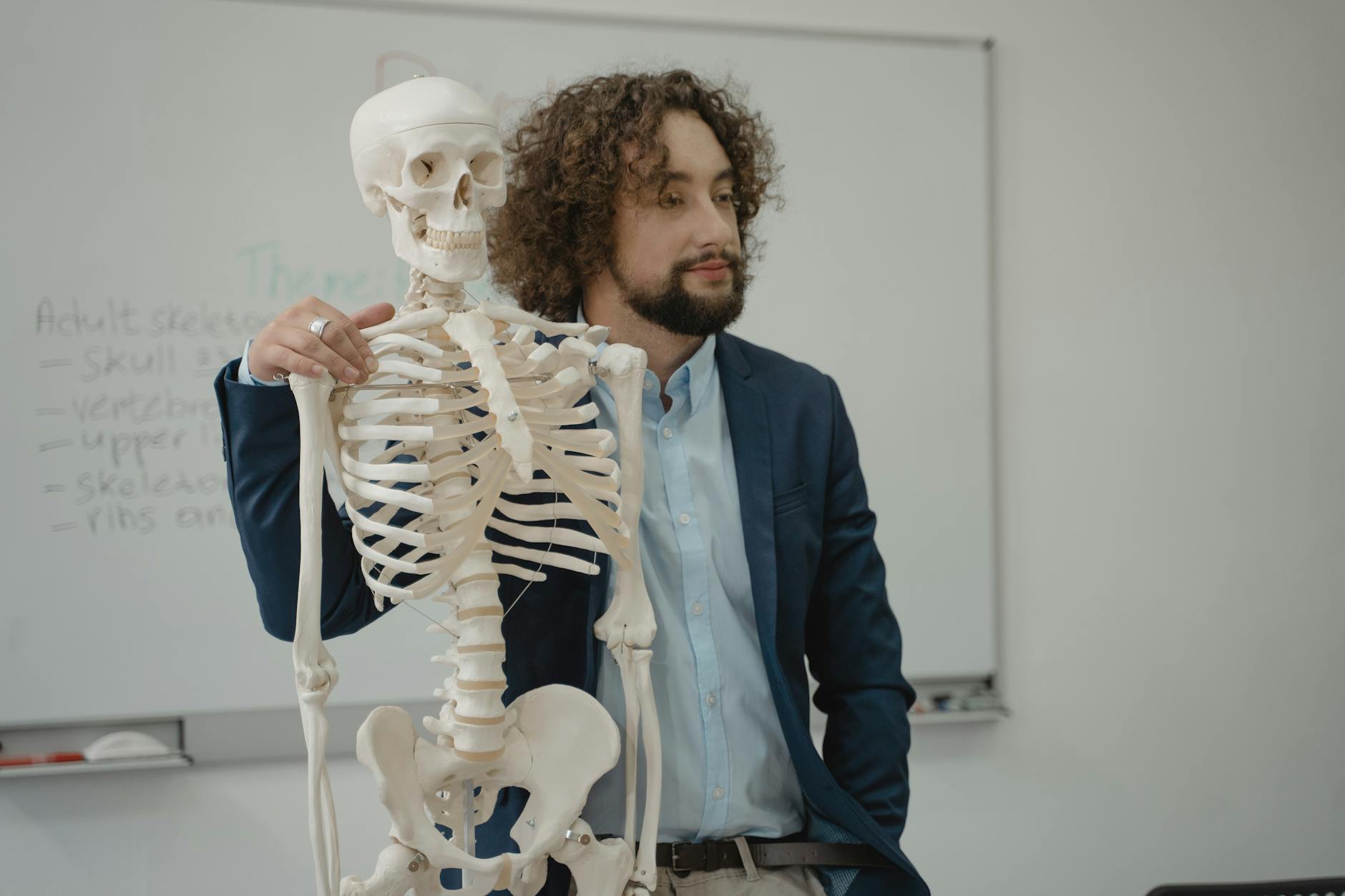
The hardest anatomy question I’ve ever asked a room had nothing to do with obscure Latin terms or rare conditions. It was about the number of bones in the human hand. People who’d never taken a biology class got it closer than the pre-med students, because the students overthought it and the civilians just looked down at their fingers and started counting. That’s the thing about anatomy trivia questions. We all own the equipment. We just don’t read the manual.
The person searching for these questions already knows the basics. They know the femur is the longest bone. They know the heart is on the left (sort of). They’ve absorbed enough from school, from Grey’s Anatomy the show, and from that one friend who’s a nurse to feel reasonably confident. That confidence is exactly what makes this fun.
The Stuff You Think You Know
1. What is the largest organ of the human body?
I open with this one because it sorts the room instantly. Half the people say liver with total conviction. The other half remember this from some list they read once and feel smug about it. Both groups are useful to me.
Show Answer
The skin. It averages about 20 square feet in adults and weighs around 8 pounds. The liver is the largest internal organ, which is where the confident wrong answers come from. People forget the skin counts because they don’t think of it as an organ at all.
2. How many bones does an adult human body have?
This is one of those questions where people either know it cold or they’re wildly off. I’ve heard guesses from 150 to 500.
Show Answer
206. Babies are born with roughly 270, but many fuse together as you grow. That’s a detail worth mentioning out loud because the follow-up conversation is always better than the question itself.
3. What is the smallest bone in the human body?
Most people get the general area right. It’s the specifics that trip them up.
Show Answer
The stapes (or stirrup bone), located in the middle ear. It’s about 3 millimeters long. People who say “a bone in the ear” without naming it usually get partial credit in my rooms, because honestly, knowing it’s in the ear is the hard part.
4. The mandible is better known as what?
A warm-up for the Latin that’s coming later. This one’s a confidence builder, and every good set needs a few of those early.
Show Answer
The jawbone. It’s also the largest and strongest bone in the face.
5. What type of joint is the human knee?
I love this question because everyone’s had a knee problem or knows someone who has, and they still can’t name the joint type. It’s like not knowing what kind of engine is in the car you drive every day.
Show Answer
A hinge joint. Common wrong answer: ball-and-socket, which is what the hip and shoulder are. The knee bends in one plane, like a door hinge. That simplicity is exactly why it’s so vulnerable to injury from lateral forces.
Where the Floor Starts to Move
6. What is the only bone in the human body that doesn’t articulate with any other bone?
This one creates a beautiful silence. People start mentally scanning their skeleton like they’re running a diagnostic.
Show Answer
The hyoid bone, a small U-shaped bone in the neck that supports the tongue. It’s anchored by muscles and ligaments but doesn’t connect to any other bone. It’s also important in forensic science because a fractured hyoid can indicate strangulation.
7. How many chambers does the human heart have?
Breather question. But you’d be surprised how many people hesitate.
Show Answer
Four: left atrium, right atrium, left ventricle, right ventricle.
8. What is the longest muscle in the human body?
People always guess something in the leg, which is correct. But they almost never name the right one.
Show Answer
The sartorius, which runs diagonally from the outer hip to the inner knee. Most people guess the quadriceps or the hamstring, which are larger but not longer. The sartorius is the tailor’s muscle, named because it assists in the cross-legged sitting position tailors traditionally used.
9. What part of the brain is primarily responsible for balance and coordination?
This is one of those questions that rewards people who paid attention during exactly one lecture in high school biology.
Show Answer
The cerebellum. It sits at the back and bottom of the brain, and despite being only about 10% of the brain’s volume, it contains more than half of all the brain’s neurons.
10. The patellar tendon connects the kneecap to what bone?
Runners and physical therapists light up when I ask this. Everyone else stares at their knees like the answer might be printed there.
Show Answer
The tibia (shinbone). The common wrong answer is the femur, which connects to the kneecap via the quadriceps tendon above. People mix up which side of the kneecap each tendon is on.
11. What are the two main proteins that make muscles contract?
This one’s a genuine filter. If you remember these names, you actually studied.
Show Answer
Actin and myosin. They slide past each other in what’s called the sliding filament theory of muscle contraction. It’s one of those things that sounds made up but is genuinely elegant biology.
12. Which organ produces bile?
The gallbladder gets blamed for everything. This question exists to correct that injustice.
Show Answer
The liver. The gallbladder stores and concentrates bile, but the liver produces it. This is the anatomy equivalent of crediting the fridge for cooking your food.
The Ones That Start Arguments
13. How many ribs do most humans have?
I’ve watched couples argue about this one. There’s a persistent belief, rooted in the Adam and Eve story, that men have one fewer rib than women. They don’t.
Show Answer
24 ribs (12 pairs), regardless of sex. About 1 in 200 people are born with a cervical rib, an extra rib above the first normal one, which can cause nerve issues. But the standard count is the same for everyone.
14. What is the hardest substance in the human body?
People who say bone are wrong, and they know it as soon as they say it. You can see the correction forming on their lips.
Show Answer
Tooth enamel. It’s harder than bone and ranks about 5 on the Mohs hardness scale, roughly the same as steel. But it can’t regenerate, which is why dentists keep telling you to floss.
15. What is the name of the large, flat muscle that separates the chest cavity from the abdominal cavity and is essential for breathing?
Singers get this one. Athletes sometimes do. Everyone else reaches for “lungs” even though the question clearly said muscle.
Show Answer
The diaphragm. When it contracts, it flattens and pulls air into the lungs. Hiccups are involuntary spasms of this muscle, which is a fact that makes people feel like hiccups are somehow more serious than they are.
16. The ulna is located in which part of the body?
Most people get the right limb. The real question is whether they know which of the two forearm bones it is.
Show Answer
The forearm. It runs from the elbow to the pinky side of the wrist. The radius is the other forearm bone, on the thumb side. An easy way to remember: the ulna points to your “ulnar nerve,” which is what you hit when you bang your funny bone.
17. What percentage of the human body is water, roughly?
Everyone’s heard a number. The problem is they’ve all heard a slightly different one.
Show Answer
About 60% in adult males and about 55% in adult females. Accepting anything from 55-65% is fair in a live room. The number decreases with age and varies with body composition, which is why this question generates more debate than it probably should.
18. What is the medical term for the shoulder blade?
Latin anatomy names are either deeply satisfying or deeply annoying depending on your relationship with medical terminology. This one’s on the satisfying end.
Show Answer
The scapula. It’s a triangular bone that floats on the back of the ribcage, connected mainly by muscles rather than by a traditional joint. “Floating” might be a strong word, but it moves more freely than most people realize.
Where It Gets Quiet
19. The islets of Langerhans are found in which organ?
This is the question where the room divides into people who’ve dealt with diabetes in their lives and people who haven’t. The first group knows this cold.
Show Answer
The pancreas. These clusters of cells produce insulin and glucagon, the hormones that regulate blood sugar. Named after Paul Langerhans, who discovered them at age 22 as a medical student in 1869.
20. What is the only organ that can regenerate itself back to its full size after partial removal?
This one always gets a reaction. It sounds like it shouldn’t be true.
Show Answer
The liver. You can remove up to 75% of a healthy liver and it will grow back to its original size within weeks. This is what makes living-donor liver transplants possible. It’s the closest thing to a superpower the human body actually has.
21. Where in the body would you find the cochlea?
The name sounds like it should be in the abdomen somewhere. It’s not.
Show Answer
The inner ear. It’s a spiral-shaped, fluid-filled structure that converts sound vibrations into nerve signals. The word comes from the Greek for “snail shell,” which is exactly what it looks like.
22. What is the name of the thick band of tissue that runs along the bottom of the foot, connecting the heel bone to the toes?
Runners and anyone over 40 know this one from painful personal experience.
Show Answer
The plantar fascia. When it gets inflamed, that’s plantar fasciitis, one of the most common causes of heel pain. I’ve never asked this question without at least one person in the room wincing in recognition.
23. How many vertebrae make up the human cervical spine?
Here’s a piece of trivia that makes the answer more interesting: almost all mammals have this same number of cervical vertebrae, from mice to giraffes.
Show Answer
Seven. A giraffe has seven cervical vertebrae. So does a mouse. So do you. Each of the giraffe’s can be over 10 inches long, but the number is the same. That fact alone has carried entire conversations at my events.
24. The Achilles tendon connects the calf muscles to which bone?
Almost everyone knows what the Achilles tendon is. Far fewer can name the bone it attaches to without guessing.
Show Answer
The calcaneus, or heel bone. It’s the strongest and largest tendon in the body, capable of handling forces of over 1,000 pounds during running. And yet it’s named after the one spot that could kill a demigod. Anatomy has a dark sense of humor.
The Last One Standing
25. The human body has more of these than it has human cells. What are they?
I save this for last because it forces a rethinking of what “your body” even means. For years, the commonly cited ratio was 10 to 1. Recent research brought that number way down, but the answer still unsettles people in the best way. When I ask this at a live event, the room goes still for a second, and then someone whispers it to their teammate like they’re not sure they believe it themselves. That’s the kind of question you end on. Not because it’s the hardest, but because it changes the shape of everything that came before it.
Show Answer
Bacterial cells. Current estimates put the ratio at roughly 1.3 bacterial cells for every 1 human cell. The old “10 to 1” figure was an overestimate, but the point holds: you are, by cell count, slightly more bacteria than human. You’ve been a colony this whole time.
I came to trivia writing through science communication, spending 4 years in Salt Lake City, UT trying to make complex topics accessible. The best science questions I write are the ones where the real answer is stranger than anything someone would guess. My rounds have been used by Quiz Night King, and I take the same care with every set I write.
Latest posts by Shannon Harris, B.Sc. Biology
(see all)