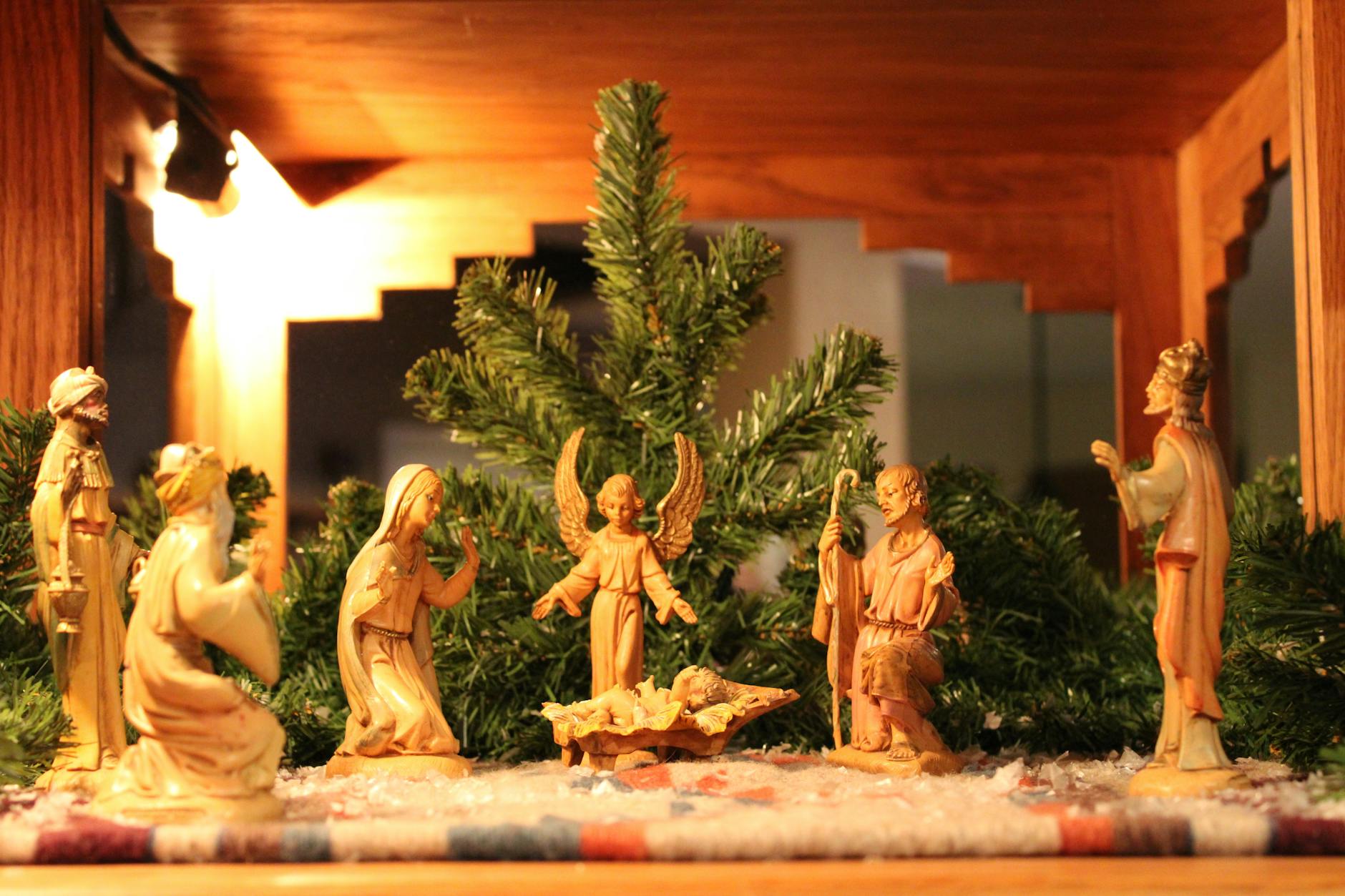
The number of wise men who visited Jesus is never mentioned in the Bible. Not once. But I’ve watched entire tables of churchgoing adults argue with me about it, certain it says three, ready to pull out their phones to prove it. They pull out their phones. They go quiet. That’s the moment I live for in bible christmas trivia: the instant someone realizes the Christmas story they’ve been carrying around since childhood was assembled from hymns, greeting cards, and a second-grade pageant where someone’s older brother played a donkey.
The actual biblical text of the nativity is shockingly spare. Two gospels cover it. Two don’t mention it at all. And the details people fight hardest to defend are almost always the ones that aren’t there. That tension between what we assume and what’s actually written is what makes these questions land so well in a room. People who’ve read the Bible cover to cover still get caught. People who haven’t read it sometimes do better, because they don’t have decades of confident assumption working against them.
Here are 60 questions. Some are gentle. Some will start arguments. A few might genuinely change how you picture the story.
The Parts Everyone Thinks They Know
1. Which two of the four Gospels contain accounts of Jesus’ birth?
I always open with this one because it immediately separates people who’ve read the text from people who assume all four gospels tell the same story. Mark starts with Jesus as an adult. John starts with cosmic poetry. Neither has a manger in sight.
Show Answer
Matthew and Luke. A common wrong answer is “all four” , people assume something this important would appear everywhere.
2. What was the name of the angel who told Mary she would bear a son?
This one’s a warm-up. But it’s worth noting that Gabriel shows up twice in the Christmas narrative, and most people only remember this appearance.
Show Answer
Gabriel (Luke 1:26-28)
3. In Luke’s Gospel, what was Mary’s response when the angel first appeared to her?
People always want to say she was afraid or that she fell to her knees. The text is more psychologically interesting than that.
Show Answer
She was “greatly troubled” (or “perplexed”) at the angel’s greeting and wondered what kind of greeting this might be (Luke 1:29). She wasn’t terrified by the angel’s appearance , she was unsettled by what he said.
4. Before visiting Mary, Gabriel appeared to another person to announce a miraculous birth. Who was it?
This is the question that reminds people the Christmas story has a prologue most pageants skip entirely.
Show Answer
Zechariah, the father of John the Baptist (Luke 1:11-13)
5. What happened to Zechariah because he doubted the angel’s message?
I love this one because it invites comparison. Mary also questioned Gabriel. But Zechariah got punished and Mary didn’t. That asymmetry has fueled theological debate for centuries.
Show Answer
He was struck mute (unable to speak) until the birth of his son John (Luke 1:20)
6. What was the name of Mary’s relative who was pregnant with John the Baptist?
Show Answer
Elizabeth (Luke 1:36)
7. When Mary visited Elizabeth, what did the baby in Elizabeth’s womb do?
This detail sticks with people once they hear it. It’s one of those moments in the text that’s stranger and more vivid than anything a pageant could stage.
Show Answer
The baby leaped in her womb (Luke 1:41)
8. Mary’s song of praise after visiting Elizabeth is known by its Latin name. What is it called?
Tables split on this one. People who grew up liturgical nail it. Everyone else stares at the ceiling.
Show Answer
The Magnificat (from Luke 1:46-55, beginning “My soul magnifies the Lord”)
The Journey and the Birth
9. Why did Joseph and Mary travel to Bethlehem?
Straightforward, but it grounds the story in something political rather than purely spiritual. A government census. Bureaucracy brought them to Bethlehem.
Show Answer
A Roman census (decree from Caesar Augustus) required Joseph to register in his ancestral town (Luke 2:1-4)
10. Which Roman emperor ordered the census that brought Joseph and Mary to Bethlehem?
Show Answer
Caesar Augustus (Luke 2:1)
11. Bethlehem was the ancestral home of which Old Testament king?
This is the theological hinge of the whole journey. Joseph’s lineage is the reason Bethlehem matters. Without David, it’s just a village.
Show Answer
King David (Luke 2:4, 1 Samuel 16:1)
12. According to the Bible, what specific type of building did Mary and Joseph fail to find room in?
Here’s where the arguments start. The Greek word is “kataluma,” and it doesn’t mean what most people think.
Show Answer
An inn, or more accurately a “guest room” , the Greek word “kataluma” refers to a guest chamber, not a commercial inn. The same word is used for the upper room of the Last Supper. Many scholars believe they were turned away from a family member’s guest room, not a hotel.
13. True or false: The Bible describes a stable where Jesus was born.
I’ve seen people get genuinely upset at this answer. The stable is so embedded in our cultural imagination that its absence from the text feels like a personal betrayal.
Show Answer
False. The Bible never mentions a stable. It says Jesus was laid in a manger (a feeding trough), which implies an area where animals were kept, but no stable, barn, or cave is described in the text.
14. What is a manger?
You’d be amazed how many people think it’s a type of building. I’ve heard “a small barn” more times than I can count.
Show Answer
A feeding trough for animals. Common wrong answer: a small shelter or stable.
15. In Luke’s account, what were the swaddling clothes that Jesus was wrapped in?
The detail matters because it’s the sign the angels give the shepherds. Not a glowing baby, not a star. A baby wrapped in cloth and lying in a feeding trough. The ordinariness of it is the point.
Show Answer
Strips of cloth used to snugly wrap a newborn , a common practice of the time, not unique to Jesus (Luke 2:7, 12)
16. True or false: The Bible says a donkey carried Mary to Bethlehem.
Show Answer
False. No donkey is mentioned anywhere in the biblical birth narratives. It’s a tradition, not Scripture.
Angels and Shepherds
17. Who were the first people to be told about Jesus’ birth (other than Mary and Joseph)?
This one’s easy on the surface, but I use it to set up harder questions about why these particular people were chosen. The answer says something about the whole story.
Show Answer
Shepherds watching their flocks at night (Luke 2:8-9)
18. What were the shepherds doing when the angel appeared to them?
Show Answer
Keeping watch over their flocks by night (Luke 2:8)
19. The angel told the shepherds they would find the baby as a “sign.” What was that sign?
Show Answer
They would find a baby wrapped in swaddling clothes and lying in a manger (Luke 2:12)
20. After the single angel delivered the news, what appeared with the angel?
People say “a choir of angels” and technically that’s close but not quite right. The text calls them something specific.
Show Answer
A great company (or multitude) of the heavenly host (Luke 2:13). They’re described as a heavenly army, not a choir , though they do praise God.
21. Complete this phrase the heavenly host declared: “Glory to God in the highest, and on earth _____.”
This splits along translation lines every single time. People who grew up with the King James say one thing. Everyone else says another. Both groups are sure they’re right.
Show Answer
“Peace, good will toward men” (KJV) or “peace to those on whom his favor rests” (NIV and other modern translations). The difference comes from a single Greek letter in the earliest manuscripts.
22. True or false: The Bible says the angels sang their message to the shepherds.
This one’s a quiet bombshell. Every Christmas carol, every church pageant, every movie has the angels singing. Open the text.
Show Answer
False. Luke 2:13-14 says they were “praising God and saying” , not singing. The tradition of angelic singing is universal but not explicitly biblical.
23. After seeing the baby, what did the shepherds do?
Show Answer
They spread the word about what they had been told about the child (Luke 2:17). They became the first evangelists of the Christmas story.
The Star and the Visitors from the East
24. The visitors from the East are commonly called “wise men.” What does Matthew’s Gospel actually call them?
The Greek word here is loaded. It carries connotations that would have made Matthew’s original audience deeply uncomfortable.
Show Answer
Magi (from the Greek “magoi”), which referred to a priestly caste from Persia associated with astrology, dream interpretation, and what the Jewish world would have considered sorcery (Matthew 2:1)
25. How many wise men (Magi) does the Bible say visited Jesus?
This is the question I mentioned at the top. The one that makes people reach for their phones. I’ve never once had a room where the majority got this right on the first try.
Show Answer
The Bible doesn’t say. It mentions three gifts, which is likely why tradition settled on three visitors, but the number is never stated. There could have been two. There could have been twelve. Common wrong answer: three.
26. What three gifts did the Magi bring?
Most people nail this one. But ask them what myrrh actually is and the room goes quiet.
Show Answer
Gold, frankincense, and myrrh (Matthew 2:11)
27. What is frankincense?
Show Answer
An aromatic resin obtained from Boswellia trees, burned as incense. It was associated with worship and priestly duties.
28. What is myrrh, and what was its symbolic significance as a gift for a newborn?
This is the gift that casts a shadow over the whole nativity if you think about it for more than a second.
Show Answer
Myrrh is a resin used as a perfume, medicine, and embalming spice. As a gift for a baby, it’s traditionally interpreted as foreshadowing Jesus’ death and burial.
29. Did the Magi visit Jesus in the manger?
Nativity sets have done real damage here. Every set on every mantelpiece puts the shepherds and the Magi in the same scene. Matthew’s Gospel disagrees.
Show Answer
No. Matthew 2:11 says the Magi came to a “house” (not a manger or stable), and the timeline suggests Jesus may have been up to two years old by the time they arrived. Common wrong answer: yes, at the manger alongside the shepherds.
30. Who was king of Judea when Jesus was born?
Show Answer
Herod the Great (Matthew 2:1)
31. When the Magi arrived in Jerusalem, who did they ask about the newborn king?
Show Answer
King Herod (Matthew 2:2). They went straight to the existing king to ask about the new one. The political naivety of this move is part of what drives the rest of the story.
32. How did Herod react when the Magi told him about the newborn “King of the Jews”?
Show Answer
He was disturbed (or troubled), and all Jerusalem with him (Matthew 2:3)
33. Herod asked his chief priests and scribes where the Messiah was to be born. What Old Testament book did they cite?
This is a satisfying one for people who know the prophets. And it catches everyone else.
Show Answer
The book of Micah (Micah 5:2), which prophesied that a ruler would come from Bethlehem
34. What did Herod secretly ask the Magi to do after they found the child?
Show Answer
Report back to him so that he too could go and worship the child (Matthew 2:8) , though his real intention was to find and kill the child.
35. How were the Magi warned not to return to Herod?
Show Answer
They were warned in a dream (Matthew 2:12)
36. By what route did the Magi go home?
Show Answer
They returned to their country by another route (Matthew 2:12)
What Came After the Birth
37. How many days after his birth was Jesus circumcised, according to Jewish law?
Show Answer
Eight days (Luke 2:21)
38. When Jesus was presented at the Temple in Jerusalem, an elderly man took him in his arms and praised God. Who was this man?
Simeon doesn’t make it into most pageants, which is a shame, because his words contain one of the most haunting lines in the entire nativity narrative.
Show Answer
Simeon (Luke 2:25-28)
39. Simeon said something unsettling directly to Mary about her son’s future. What did he tell her?
Show Answer
“A sword will pierce your own soul too” (Luke 2:35). In the middle of a joyful dedication scene, Simeon essentially tells Mary that her child’s life will break her heart.
40. An elderly prophetess was also present at the Temple when Jesus was presented. What was her name?
Show Answer
Anna (Luke 2:36)
41. How old was Anna the prophetess, roughly, according to Luke?
Show Answer
Eighty-four years old (Luke 2:37). She had been a widow for most of her life and never left the Temple.
42. After the Magi left, an angel appeared to Joseph in a dream. What did the angel tell him to do?
Show Answer
Flee to Egypt with Mary and the child, because Herod was going to search for the child to kill him (Matthew 2:13)
43. What is the name given to Herod’s order to kill young children in Bethlehem?
This is the part of the Christmas story that never makes it onto a greeting card. It’s brutal, and it’s in Matthew’s Gospel right alongside the star and the gifts.
Show Answer
The Massacre (or Slaughter) of the Innocents (Matthew 2:16-18)
44. Herod ordered the killing of all boys in Bethlehem who were how old or younger?
Show Answer
Two years old and under (Matthew 2:16), based on the time he had learned from the Magi when the star first appeared.
45. Matthew says the flight to Egypt fulfilled a prophecy from which Old Testament book?
Show Answer
Hosea (“Out of Egypt I called my son” , Hosea 11:1, cited in Matthew 2:15)
46. After Herod died, where did Joseph’s family settle when they returned from Egypt?
Show Answer
Nazareth, in the region of Galilee (Matthew 2:23)
Names, Prophecies, and Genealogies
47. The name “Jesus” comes from a Hebrew name. What does it mean?
Show Answer
“The Lord saves” or “Yahweh is salvation” , from the Hebrew Yeshua/Joshua (Matthew 1:21)
48. What does the title “Emmanuel” (or “Immanuel”) mean?
Show Answer
“God with us” (Matthew 1:23, referencing Isaiah 7:14)
49. Which Old Testament prophet wrote “For unto us a child is born, unto us a son is given”?
Handel’s Messiah has made this one feel familiar even to people who’ve never opened Isaiah. The music does the work of memory.
Show Answer
Isaiah (Isaiah 9:6)
50. Matthew and Luke both give genealogies of Jesus, but they differ significantly. Whose lineage does Matthew trace Jesus back to?
Show Answer
Abraham (Matthew 1:1-2). Luke, by contrast, traces the genealogy all the way back to Adam.
51. Matthew’s genealogy of Jesus includes four women besides Mary, which was unusual for Jewish genealogies. Name any one of them.
This question always sparks conversation because every one of these women has a story that would raise eyebrows in polite company. Their inclusion is deliberate and disruptive.
Show Answer
Tamar, Rahab, Ruth, or Bathsheba (referred to as “Uriah’s wife”) , Matthew 1:3-6
52. In Matthew’s Gospel, how did Joseph first learn that Mary was pregnant?
Show Answer
He found out she was pregnant before they came together as husband and wife (Matthew 1:18). The angel appeared to him afterward, in a dream, to explain.
53. What was Joseph’s initial plan when he discovered Mary was pregnant?
I find this one of the most humanly relatable moments in the whole narrative. Joseph’s first instinct wasn’t rage. It was quiet damage control.
Show Answer
He planned to divorce her quietly, so as not to expose her to public disgrace (Matthew 1:19)
54. What was Joseph’s occupation?
The Greek word is “tekton,” and it’s broader than most people assume.
Show Answer
A carpenter, or more precisely a craftsman/builder , the Greek “tekton” could refer to anyone who worked with wood, stone, or metal (Matthew 13:55)
The Details That Slip Through
55. Which Gospel mentions the star of Bethlehem?
People assume both nativity gospels include it. Only one does.
Show Answer
Only Matthew (Matthew 2:2, 9-10). Luke never mentions a star. Common wrong answer: both Matthew and Luke.
56. According to Matthew, what did the star do when the Magi were traveling from Jerusalem to Bethlehem?
Show Answer
It went ahead of them and stopped over the place where the child was (Matthew 2:9). The star doesn’t just hang in the sky , it moves and then parks.
57. True or false: The Bible specifies the date or time of year when Jesus was born.
This one gets a groan every time, because everyone already suspects the answer but doesn’t want it confirmed during their Christmas party.
Show Answer
False. No date is given anywhere in Scripture. December 25th was established by tradition centuries later. The detail about shepherds watching flocks at night has led many scholars to argue for a spring or autumn birth.
58. Luke mentions a specific detail about Jesus’ birth that suggests he was Mary’s firstborn. What phrase does he use?
Show Answer
“She gave birth to her firstborn, a son” (Luke 2:7). The word “firstborn” has fueled centuries of debate about whether Mary had other children.
59. In Luke’s account, after everything that happened , the angels, the shepherds, the prophecies , what does the text say Mary did with all these things?
This verse is two lines long and it’s one of the most quietly devastating moments in the entire Bible. After all the spectacle, Luke gives us this.
Show Answer
“Mary treasured up all these things and pondered them in her heart” (Luke 2:19)
60. Which two Gospels say nothing at all about Jesus’ birth, childhood, or any event before his adult ministry?
I always close with this one. After sixty questions about every detail of the Christmas story , the angels, the star, the gifts, the flight to Egypt , it’s worth sitting with the fact that half the Gospel writers didn’t consider any of it worth mentioning. Mark opens with a man walking out of the desert. John opens with “In the beginning was the Word.” Two completely different ways of saying: the story that matters starts here. It doesn’t diminish the nativity. But it reframes it. The Christmas story isn’t the foundation of the Gospels. It’s the prologue that two writers chose to include and two chose to skip. And somehow, from those two spare accounts, we built an entire world of mangers and stars and songs that most of us can’t separate from the text anymore. That’s the real magic of bible christmas trivia. Not catching people out, but watching them rediscover a story they thought they already knew.
My 8 years running trivia nights in Oslo, Norway have taught me more about writing good questions than any training could. The room tells you everything. I write based on what works in front of real people, not what looks clever on paper. My question packs have featured on Buzzfeed Quizzes, and I take the same care with every set I write.
Latest posts by Felix Schneider
(see all)