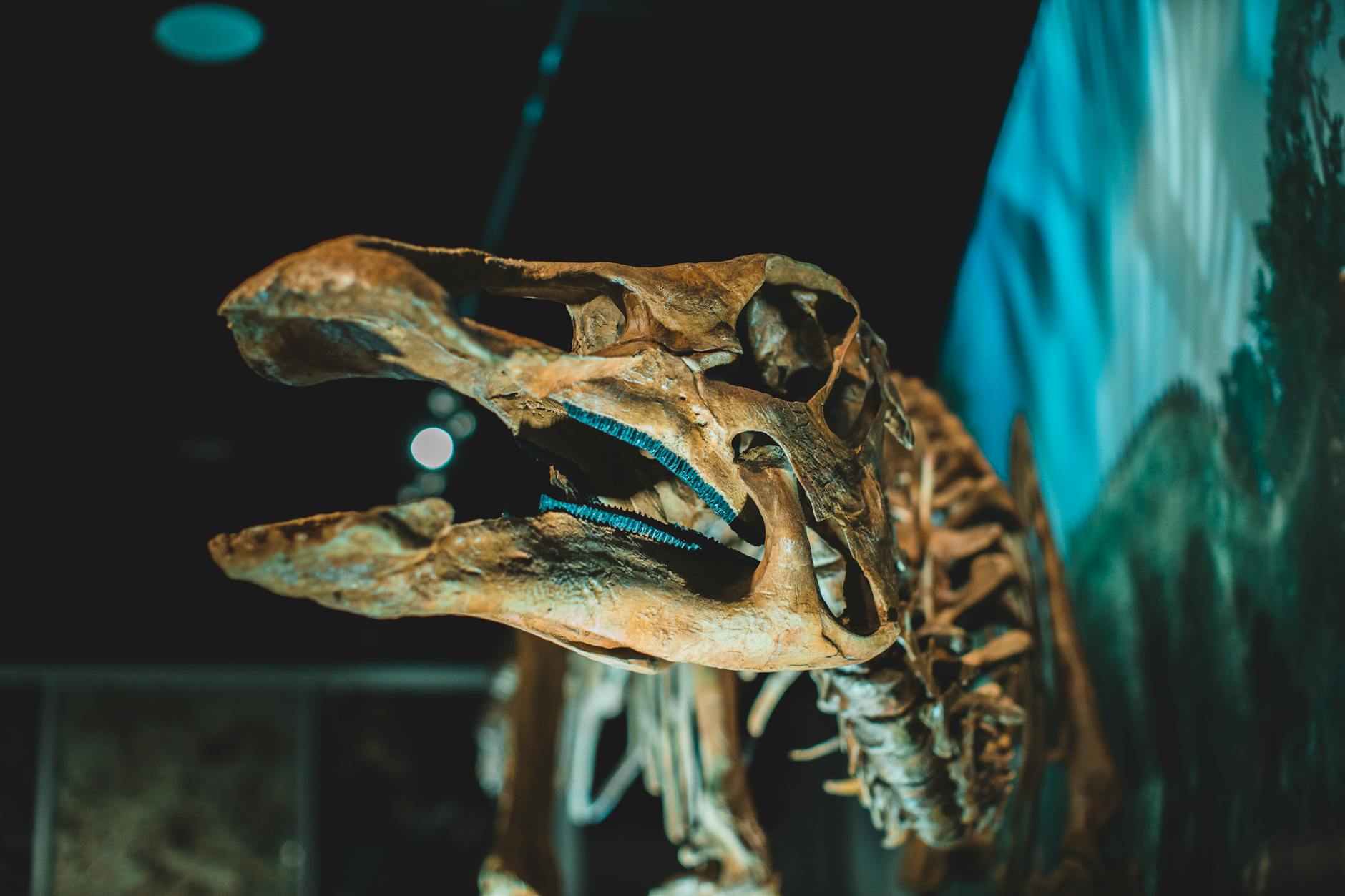
Stegosaurus was already a fossil when T. rex was alive. That one fact, more than anything I’ve ever said into a microphone, has caused the most arguments at trivia nights. People don’t believe it. They’ll argue with you. They’ll pull out their phones. And then they go quiet, because the Mesozoic is so much longer and stranger than the version we carry around in our heads. We all grew up with the same plastic toy bin version of dinosaurs, and it turns out that version left out almost everything interesting.
I’ve been running dinosaur trivia rounds for years, and here’s what I’ve learned: everyone thinks they’re a dinosaur expert. Something about being seven years old and memorizing species names never fully leaves the brain. That confidence is exactly what makes this topic so much fun to play with. The stuff you learned at seven is often wrong, and the stuff that’s actually true is wilder than any of it.
These 50 questions are built from that gap between what people think they know and what’s real. Some will feel easy. Some will make you angry. A few might genuinely change how you think about these animals.
The Ones You Think You Know
1. What does the word “dinosaur” literally mean in Greek?
This one’s a warm-up, but I love watching people’s faces when they actually think about the translation. It was coined in 1842, and the guy who came up with it wasn’t going for cute.
Show Answer
“Terrible lizard” (from deinos + sauros). Richard Owen coined the term, and “terrible” here meant something closer to “fearfully great” than “bad.” Most people get this one, but almost nobody knows Owen’s name.
2. Which period came first: Triassic, Jurassic, or Cretaceous?
You’d think Spielberg would’ve sorted this out for everyone, but naming your blockbuster after the middle period really did a number on public understanding of geological time.
Show Answer
Triassic (roughly 252 to 201 million years ago). The most common wrong answer is Jurassic, because the movie made it the default “dinosaur word” for an entire generation.
3. Tyrannosaurus rex lived during which geological period?
This is where the overconfidence starts. I’ve had tables shout “Jurassic” with absolute certainty.
Show Answer
The Cretaceous period, specifically the late Cretaceous, around 68 to 66 million years ago. T. rex was one of the last non-avian dinosaurs. People say Jurassic because, again, Spielberg.
4. What is the name of the mass extinction event that wiped out the non-avian dinosaurs approximately 66 million years ago?
I phrase it this way on purpose. “Non-avian” does a lot of work in that sentence, and the teams that catch it are already looking at me sideways.
Show Answer
The Cretaceous-Paleogene (K-Pg) extinction event, formerly called the Cretaceous-Tertiary (K-T) extinction. It was caused by an asteroid impact, volcanic activity, or most likely both working together.
5. Where did the asteroid that contributed to the dinosaurs’ extinction strike Earth?
The crater is still there. You can’t see it from the ground, but you can from space, and the cenotes in the Yucatán trace its edge like a scar.
Show Answer
The Yucatán Peninsula in Mexico, creating the Chicxulub crater. The crater is about 150 kilometers (93 miles) in diameter and is buried under sediment.
6. What are living descendants of dinosaurs that you can see today?
Every time I ask this, someone says “crocodiles.” Every single time. And every time, a different person at the table looks at them like they just failed a basic test of reality.
Show Answer
Birds. Birds are literally dinosaurs, classified within the clade Dinosauria. Crocodilians are archosaurs and closely related, but they’re not dinosaurs. The pigeon outside your window has a more direct claim to the dinosaur name than any reptile at the zoo.
Where the Floor Starts Tilting
7. What dinosaur name means “three-horned face”?
Show Answer
Triceratops. One of the few dinosaur names that does exactly what it says on the tin.
8. Velociraptors, as they actually existed, were roughly the size of what modern animal?
This is one of my favorites to ask in a room. Half the people picture the Jurassic Park version. The other half have been waiting their entire lives for someone to ask this so they can correct everybody.
Show Answer
A turkey. Real Velociraptors were about 1.5 to 2 feet tall and weighed around 15 to 33 pounds. They also had feathers. The Jurassic Park “Velociraptors” were actually modeled closer to Deinonychus, which was significantly larger.
9. What was the primary diet of the enormous long-necked sauropods like Brachiosaurus?
Show Answer
Plants. Sauropods were herbivores. Their long necks likely evolved to reach high vegetation, though some paleontologists argue they may have used them to sweep across wide areas at lower levels too. The debate is still live.
10. Which dinosaur is known for the large sail-like structure on its back?
Two correct answers float around for this one, and the argument about which one I “meant” has genuinely delayed rounds.
Show Answer
Spinosaurus. Though Dimetrodon also had a sail, it wasn’t actually a dinosaur. It was a synapsid, more closely related to mammals. If someone says Dimetrodon, you get to watch them process that information in real time, and it’s wonderful.
11. What feature of Pachycephalosaurus gives it its name?
Show Answer
Its thick skull (the name means “thick-headed lizard”). The dome of bone on its head could be up to 10 inches thick. Whether they actually headbutted each other is debated. Some evidence suggests the dome wasn’t built to absorb direct impacts.
12. The largest known flying reptile of the Mesozoic era, with a wingspan estimated up to 33 feet, was not a dinosaur. What was it?
I love this question because it forces people to confront the fact that pterosaurs aren’t dinosaurs, and most of them have never once thought about that distinction.
Show Answer
Quetzalcoatlus. It was a pterosaur, not a dinosaur. Pterosaurs were flying reptiles that lived alongside dinosaurs but belonged to a separate group. The common wrong answer is Pteranodon, which was also huge but not quite this massive.
13. What color were dinosaurs?
This isn’t a trick question. We actually know the answer for some species now, which would’ve been unthinkable twenty years ago.
Show Answer
It varies by species, and we now have direct evidence for some. Sinosauropteryx, for example, had a reddish-brown and white striped tail. Microraptor had iridescent black feathers, like a crow. Scientists determine this by analyzing fossilized melanosomes, the structures that produce pigment.
14. What is the name of the armored dinosaur known for its heavy club-like tail?
Show Answer
Ankylosaurus. That tail club could generate enough force to break bone. It’s basically a biological mace, and it’s one of the best examples of a dinosaur that evolved to be a walking tank.
The Ones That Start Arguments
15. True or false: T. rex could run faster than a human.
This one splits rooms. People who grew up on Jurassic Park are positive it could outrun a Jeep. People who’ve read one article about biomechanics are positive it couldn’t jog.
Show Answer
Likely false, or at best debatable. Recent biomechanical studies suggest T. rex’s top speed was probably around 12 to 17 mph, while an average human sprints at about 15 mph and Usain Bolt hit nearly 28. Its leg bones would have fractured at higher speeds due to its mass. But this is still actively debated, and new studies shift the estimates regularly.
16. What is the largest dinosaur ever discovered, by current estimates?
The answer to this changes every few years, which is part of what makes it a great pub question. Someone always has an outdated but confident answer.
Show Answer
Argentinosaurus or Patagotitan, depending on the estimate and which measurement you use (length vs. mass). Patagotitan mayorum is often cited at around 70 tons and 100+ feet long. But fragmentary remains of other titanosaurs might have been larger. The honest answer is we’re not totally sure, and that uncertainty is the interesting part.
17. What was the smallest known dinosaur?
People always guess something obscure. The answer is sitting on your bird feeder.
Show Answer
The bee hummingbird (Mellisuga helenae) is technically the smallest living dinosaur at about 2 inches long. If we’re talking non-avian dinosaurs, Microraptor and Epidexipteryx are among the smallest at roughly the size of a pigeon. The common wrong answer is Compsognathus, which was small but not the smallest.
18. Did Tyrannosaurus rex have feathers?
You want to see a room divide? Ask this one. The feathered T. rex debate gets personal fast.
Show Answer
Probably some, at least during part of its life. Close relatives like Yutyrannus had extensive feathering, but skin impressions from adult T. rex show scales on several body parts. The current thinking is that adults may have been mostly scaly with some feathered areas, or that juveniles were feathered and lost them as they grew. It’s not settled.
19. How long did dinosaurs roam the Earth: roughly 20 million years, 80 million years, or 165 million years?
The scale of this answer is what gets people. We’ve been around for maybe 300,000 years as a species. Let that sit for a second.
Show Answer
Approximately 165 million years (from the late Triassic, around 231 million years ago, to the K-Pg extinction 66 million years ago). Humans in our current form have existed for roughly 0.2% of that time.
20. Were Stegosaurus and T. rex alive at the same time?
This is the one I mentioned at the top. It’s the single best dinosaur trivia question I know, because the answer rewires how people think about time.
Show Answer
No. Stegosaurus went extinct about 80 million years before T. rex appeared. The gap between Stegosaurus and T. rex is greater than the gap between T. rex and us. That fact tends to make people stare at the table for a while.
Deeper Than the Bone Bed
21. What country has produced the most dinosaur species discoveries?
Show Answer
The United States, followed closely by China and Argentina. The American West, particularly Montana, Wyoming, and Utah, has been a dinosaur goldmine since the 1800s. But China has been closing the gap fast, especially with feathered dinosaur discoveries.
22. What was the “Bone Wars”?
One of the best stories in the history of science, and it involves two grown men basically trying to destroy each other over fossils.
Show Answer
A fierce rivalry between paleontologists Othniel Charles Marsh and Edward Drinker Cope in the late 1800s. They bribed each other’s workers, destroyed fossils to prevent the other from claiming them, and rushed publications with errors. Despite the chaos, they discovered over 130 new species between them.
23. What dinosaur’s name means “egg thief,” even though it was later found to have been protecting its own eggs?
This is one of the great injustices in naming history. This animal got slandered for decades.
Show Answer
Oviraptor. When first discovered in 1924 near a nest of eggs, scientists assumed it was stealing them. Decades later, more specimens were found brooding on nests of the same type of eggs. It was a devoted parent, not a thief.
24. What adaptation did Spinosaurus have that suggests it spent significant time in water?
Show Answer
It had dense bones (unusual for a theropod, more like those of hippos and penguins), a paddle-like tail, and nostrils positioned high on its skull. Recent research suggests it was semi-aquatic, possibly hunting fish and swimming in rivers. It’s the first dinosaur found with evidence of an aquatic lifestyle.
25. What is a coprolite?
I always wait a beat before revealing this one. The room’s reaction is never not funny.
Show Answer
Fossilized feces. Dinosaur poop, preserved in stone. Coprolites are genuinely valuable to paleontology because they tell us what dinosaurs ate. One famous T. rex coprolite contained crushed bone fragments, confirming it could pulverize bone.
26. What dinosaur had the longest neck relative to its body?
Show Answer
Mamenchisaurus, whose neck could reach up to 35 feet long, roughly half its total body length. Some estimates put it even longer. It had 19 vertebrae in its neck alone.
27. What is the term for the study of ancient life, including dinosaurs?
Show Answer
Paleontology. And no, it’s not the same as archaeology. Archaeology studies human history through artifacts. Paleontology studies life through fossils. Mixing these up in a room full of science nerds will get you corrected before you finish the sentence.
28. Which continent is the only one where dinosaur fossils have NOT been found?
People guess wrong on this more often than you’d think. They forget how big some continents were during the Mesozoic.
Show Answer
Trick implied, but the real answer: dinosaur fossils have been found on all seven continents, including Antarctica. Cryolophosaurus was discovered there in 1991. Antarctica was much warmer during the Mesozoic and connected to other landmasses.
29. What was unique about Therizinosaurus’s claws?
Show Answer
They were up to 3 feet long, the longest claws of any known animal ever. Despite looking terrifying, Therizinosaurus was likely an herbivore that used those claws to pull down branches. Nature’s most intimidating vegetarian.
30. What is the difference between a “saurischian” and an “ornithischian” dinosaur?
This is the question that separates the casual fans from the people who actually read about this stuff. And even some of the readers get the implication backward.
Show Answer
It’s based on hip structure. Saurischians (“lizard-hipped”) include theropods and sauropods. Ornithischians (“bird-hipped”) include stegosaurs, ankylosaurs, and ceratopsians. Here’s the twist that gets people: birds evolved from saurischians, the lizard-hipped group, not the bird-hipped one. The naming is genuinely misleading.
Pop Culture Collides with the Fossil Record
31. In the original Jurassic Park film, what dinosaur is not actually from the Jurassic period?
Show Answer
Most of them, honestly, but the standout is T. rex, which is from the Cretaceous. So is Velociraptor. And Gallimimus. Dilophosaurus is one of the few that actually lived during the Jurassic. The movie is basically misnamed.
32. What feature did the Jurassic Park movies invent for Dilophosaurus that has no basis in the fossil record?
Show Answer
The neck frill and venom-spitting. There’s zero fossil evidence that Dilophosaurus had a frill or could spit anything. It was also much larger than depicted in the film, around 20 feet long. Spielberg made it smaller so audiences wouldn’t confuse it with the raptors.
33. What children’s TV show featured a purple T. rex who loved hugs?
A palate cleanser. But I’ve seen adults get weirdly emotional about this one.
Show Answer
Barney & Friends. Barney the Dinosaur debuted in 1992 and became one of the most beloved and simultaneously most mocked children’s characters in television history.
34. What was the name of the dinosaur in the original Toy Story that was anxious about being replaced?
Show Answer
Rex, voiced by Wallace Shawn. A plastic Tyrannosaurus who was terrified of everything. One of the best casting decisions in animation history.
35. The 1933 film King Kong featured stop-motion dinosaurs. Who created those effects?
Show Answer
Willis O’Brien. His work on King Kong pioneered stop-motion creature effects and directly inspired Ray Harryhausen, who would go on to define the genre for decades.
36. In what year was the first nearly complete dinosaur skeleton found in the United States?
Show Answer
1858. It was a Hadrosaurus foulkii, discovered in Haddonfield, New Jersey. This find was a turning point because it was one of the first to suggest that some dinosaurs were bipedal, not just oversized lizards dragging their bellies.
The Questions That Make People Quiet
37. What is the only dinosaur group known to have achieved powered flight?
Show Answer
Theropods, specifically the lineage leading to modern birds. Other dinosaurs like Microraptor could glide using four wings, but true powered flight evolved only in the avian lineage. Pterosaurs could fly but weren’t dinosaurs.
38. What mineral typically replaces original bone during the fossilization process?
Show Answer
Most commonly, minerals like calcite, silica, or pyrite replace the original bone material through a process called permineralization. The specific mineral depends on the surrounding sediment. This is why fossils feel like rock. They are rock.
39. Approximately what percentage of all dinosaur species that ever lived do scientists estimate we’ve discovered?
This one always lands hard. It makes people realize how little we actually know.
Show Answer
Estimates vary, but many paleontologists suggest we’ve discovered fewer than 30% of all dinosaur genera that existed, and possibly far less. Some estimates put it below 10%. The fossil record is incredibly incomplete. Most dinosaurs lived in environments that didn’t favor preservation.
40. What is “soft tissue” preservation, and why did its discovery in a T. rex femur shock the scientific world in 2005?
Show Answer
Paleontologist Mary Schweitzer discovered what appeared to be flexible blood vessels, cells, and proteins inside a 68-million-year-old T. rex bone. This was thought impossible because organic material was believed to degrade completely over such timescales. It challenged fundamental assumptions about fossilization and opened new avenues for studying dinosaur biology at the molecular level.
41. What evidence suggests that some dinosaurs lived in herds?
Show Answer
Bonebeds containing dozens or hundreds of individuals of the same species (like Centrosaurus), parallel trackways showing groups moving together, and nesting sites with multiple nests in close proximity. Some bonebeds show animals of different ages, suggesting multi-generational groups.
42. What is the name of the feathered dinosaur discovered in China in 1996 that provided some of the first direct evidence linking dinosaurs to birds?
Show Answer
Sinosauropteryx. It was the first non-avian dinosaur found with evidence of feather-like structures. The discovery in Liaoning Province was a landmark moment in paleontology and essentially settled the dinosaur-bird connection debate for most scientists.
43. What dinosaur had the largest skull of any land animal ever?
Show Answer
Pentaceratops or Torosaurus, depending on the specimen and measurement. Some Torosaurus skulls reached over 8.5 feet long. The common wrong guess is T. rex, whose skull was massive but shorter, around 5 feet.
44. How did sauropods like Apatosaurus likely eat enough food to sustain their enormous bodies?
Show Answer
They didn’t chew. Sauropods swallowed vegetation whole or with minimal processing, relying on their massive digestive systems (possibly aided by gastroliths, or stomach stones) to break it down. Their peg-like or rake-like teeth were designed for stripping leaves, not grinding. This let them eat continuously without the bottleneck of chewing.
45. What dinosaur’s name means “different lizard” and is often confused with Brontosaurus?
Show Answer
Apatosaurus. For over a century, Brontosaurus was considered a synonym of Apatosaurus. A 2015 study argued they were distinct genera after all, resurrecting the Brontosaurus name. But the debate isn’t fully settled, and mentioning it at a trivia night is a guaranteed way to start a sidebar that lasts fifteen minutes.
The Deep Cuts
46. What was unusual about the arms of Deinocheirus, the “terrible hand,” when they were first discovered in 1965?
Show Answer
Only the arms were found initially, and they were enormous: about 8 feet long with huge claws. For nearly 50 years, scientists had no idea what the rest of the animal looked like. When more complete specimens were finally found in 2014, it turned out to be a bizarre, hump-backed, duck-billed ornithomimosaur. Nobody predicted that.
47. What is a “trace fossil,” and how does it differ from a body fossil?
Show Answer
A trace fossil preserves evidence of an organism’s activity rather than its body. Footprints, trackways, burrows, coprolites, and tooth marks are all trace fossils. Body fossils preserve the actual organism (bones, teeth, shells). Trace fossils often tell us more about behavior than body fossils can.
48. What theropod dinosaur, discovered in Argentina, is one of the largest land predators ever found and rivals T. rex in size?
Show Answer
Giganotosaurus. It lived about 30 million years before T. rex and may have been slightly longer, though probably lighter. Carcharodontosaurus from North Africa is another contender. The “biggest predator” title is genuinely contested and depends on whether you measure by length, mass, or skull size.
49. Dinosaurs had a type of breathing system more efficient than mammals. What modern animals share this system?
Show Answer
Birds. Dinosaurs (at least theropods and sauropods) had a system of air sacs connected to their lungs, similar to modern birds. This allows for a one-directional airflow that extracts oxygen more efficiently than mammalian lungs. It may have helped sauropods get enough oxygen to support their massive bodies and helped theropods sustain high activity levels.
50. If you could extract DNA from a dinosaur fossil, could you clone a dinosaur?
I save this one for last because it’s the question everyone actually wants to ask. It’s the question the whole genre of dinosaur fascination builds toward. And the answer, when you really sit with it, is more interesting than any movie.
Show Answer
No, at least not with any technology we have or can currently imagine. DNA has a half-life of approximately 521 years, meaning that even under ideal preservation conditions, it would be completely degraded long before 66 million years. The oldest recovered DNA is from organisms roughly one to two million years old. No dinosaur DNA has ever been recovered, and it almost certainly never will be. The dream dies on chemistry, not ambition. But here’s the thing: scientists are working on reverse-engineering dinosaur traits from bird DNA by activating dormant ancestral genes. We can’t bring them back, but we might be able to nudge their descendants backward. That’s not Jurassic Park. It’s stranger and more real.
That last question is where I always end, because it takes the thing that brought most of us to dinosaurs in the first place and makes it honest. The fantasy of resurrection bumps up against the reality of molecular decay, and what’s left is somehow better: the idea that the animals are still here, disguised as sparrows and hawks and the heron standing in your local pond. They didn’t all die. They just changed so much we stopped recognizing them.
Science and nature rounds have a reputation for being the quizmasters' revenge. I write mine from Phoenix, AZ with the opposite goal: questions where genuine curiosity gets rewarded. 14 years of writing them has convinced me that's possible. I've contributed question sets to Sporcle, and I take the same care with every set I write.
Latest posts by Nicole Martin
(see all)